 EN
EN AR
AR ZH
ZH UZ
UZ HI
HI UR
UR FA
FA FR
FR VI
VI
Vietnam Tea Exports 2026: Volume, Prices and Top Markets
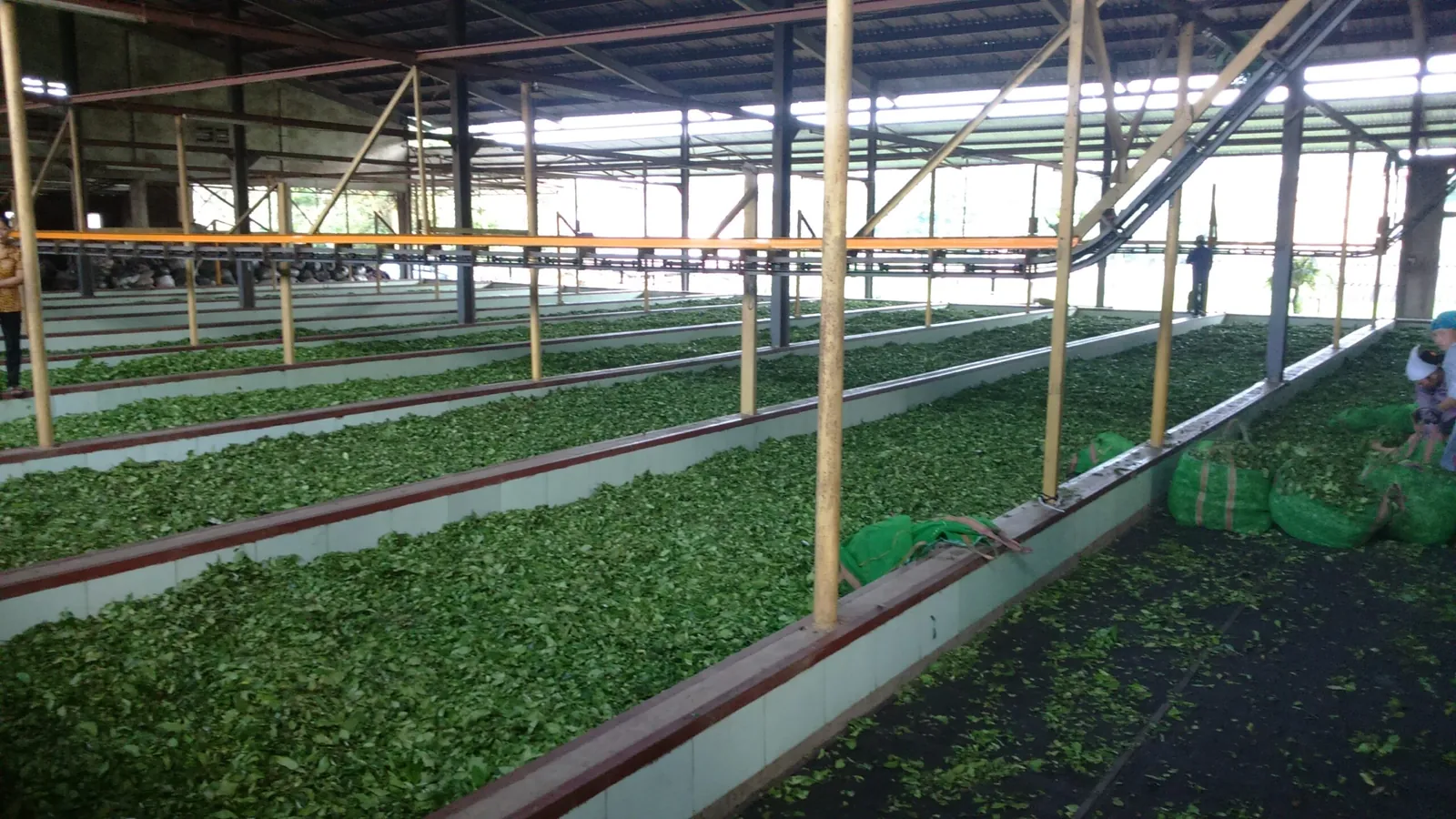
Vietnam exported 136,952 metric tons of tea worth $237.9 million in 2025, according to Vietnam Customs, at an average price of $1,737 per ton: 7.1% less by volume and 7.2% less by value than in 2024. In the first eight months of 2026, Vietnam tea exports fell to 77,256 tons, down 9.8% on a year earlier, but the average price rose to $1,857 per ton, so their value slipped only 1.5%, to $143.5 million. In 2025, Pakistan, Taiwan and mainland China took 53% of export value. This page collects the official figures on volume, value, prices, markets, growing regions and the government's 2030 plan, with a source for every number, and explains what they mean for tea buyers.
Last updated 4 October 2026, with Vietnam Customs data to August 2026.
Vietnam tea exports at a glance
- January–September 2026: $167.9 million, up 0.4% in value, with volume down 7.7% and the average price up 8.7%, according to an estimate by the Ministry of Agriculture and Environment (MAE).
- Largest market: Pakistan, with 41,337 tons worth $79.5 million in 2025, or 30% of the volume and 33% of the value.
- World position: the world's fifth-largest tea exporter, according to VietnamPlus.
- Production: 1,161,400 tons of fresh tea leaf in 2025, up 0.6%; about 122,000 hectares were under tea in 2024.
- 2030 plan: 120,000–125,000 ha and 1.2–1.4 million tons of fresh leaf, split evenly between green and black tea products.
| Year | Объем (тонн) | Стоимость (млн US$) | Average price (US$/ton) | Change in value |
|---|---|---|---|---|
| 2020 | 134,964 | 217.7 | 1,613 | -7.8% |
| 2021 | 126,779 | 213.8 | 1,687 | -1.8% |
| 2022 | 146,074 | 236.5 | 1,619 | +10.6% |
| 2023 | 119,794 | 208.2 | 1,738 | -12.0% |
| 2024 | 146,107 | 256.4 | 1,755 | +23.2% |
| 2025 | 136,952 | 237.9 | 1,737 | -7.2% |
| Jan–Aug 2026 | 77,256 | 143.5 | 1,857 | -1.5% |
Sources: Vietnam Customs export tables for 2021 (final), 2022, 2023, 2024, 2025 and January–August 2026; 2020 is the customs figure reported by agro.gov.vn. Figures from 2022 on are preliminary. Average price is value divided by volume (our calculation); changes are against the previous year, or January–August 2025 for 2026.
Exports moved between about 120,000 and 146,000 tons a year with no lasting trend. The 2023 total was the lowest in seven years (VnExpress), and the average price stayed between about $1,610 and $1,760 per ton until 2026.
2026 so far: fewer tons, higher prices
From January to August 2026, Vietnam tea exports were 9.8% lower in volume than a year earlier, but the average price was 9.2% higher, according to Vinanet, the trade information service of the Ministry of Industry and Trade (MOIT). The MAE's nine-month estimate shows the same pattern: higher prices offset part of the fall in volume.
Most of the fall came from Pakistan, which took 11,902 tons in January–August 2026, 60% less than a year earlier. In late 2025 nearly 500 containers of Vietnamese tea were stranded at Karachi after Pakistan tightened controls on overland transit to Afghanistan; most of those lots had been sold to Afghanistan and were moving through Karachi in transit (Công Thương). On 31 December 2025 Pakistan allowed them to be re-exported to other ports (Vietnam News). Monthly shipments have since recovered from their low point: Vietnam sent 3,970 tons to Pakistan in August 2026, a third of the eight-month total, though still less than the 6,115 tons of August 2025.
Other markets grew. In January–August 2026, exports to Russia rose 23% in volume, to the United States 36% in value (to $7.6 million) and to Saudi Arabia 27% in value, while volumes to China (down 21%), Indonesia (down 33%), India (down 32%) and Iraq (down 54%) fell, calculated from the customs country tables for August 2026 and August 2025.
Where Vietnamese tea goes
The ten markets below took 73% of the value of Vietnam tea exports in 2025, led by Pakistan, Taiwan and China.
| Market | Volume 2025 (tons) | Value 2025 (US$ million) | Share of value | Change in value vs 2024 |
|---|---|---|---|---|
| Pakistan | 41,337 | 79.5 | 33.4% | -25.6% |
| Taiwan | 14,033 | 26.4 | 11.1% | +1.7% |
| Китай | 13,661 | 20.2 | 8.5% | +7.3% |
| Russia | 5,288 | 9.8 | 4.1% | -18.4% |
| United States | 5,845 | 8.5 | 3.6% | -25.5% |
| Iraq | 4,755 | 7.5 | 3.2% | +49.8% |
| Indonesia | 6,310 | 6.5 | 2.7% | -39.5% |
| Saudi Arabia | 2,277 | 5.9 | 2.5% | +0.3% |
| India | 3,755 | 5.3 | 2.2% | +27.5% |
| Malaysia | 6,639 | 5.1 | 2.1% | +18.5% |
Source: Vietnam Customs, exports by country and main commodity, 2025 and 2024 (preliminary). Shares and changes are calculated by us. The table lists tea separately for 19 markets, which took 79% of the volume; the rest went to markets it does not break out.
Average prices differ widely by market, reflecting the grades each market buys. In 2025 they ranged from $763 per ton for Malaysia and $1,035 for Indonesia to $1,923 for Pakistan and $2,585 for Saudi Arabia, and the 218 tons shipped to Germany in January–August 2026 averaged $5,724 per ton (all calculated from the customs tables).
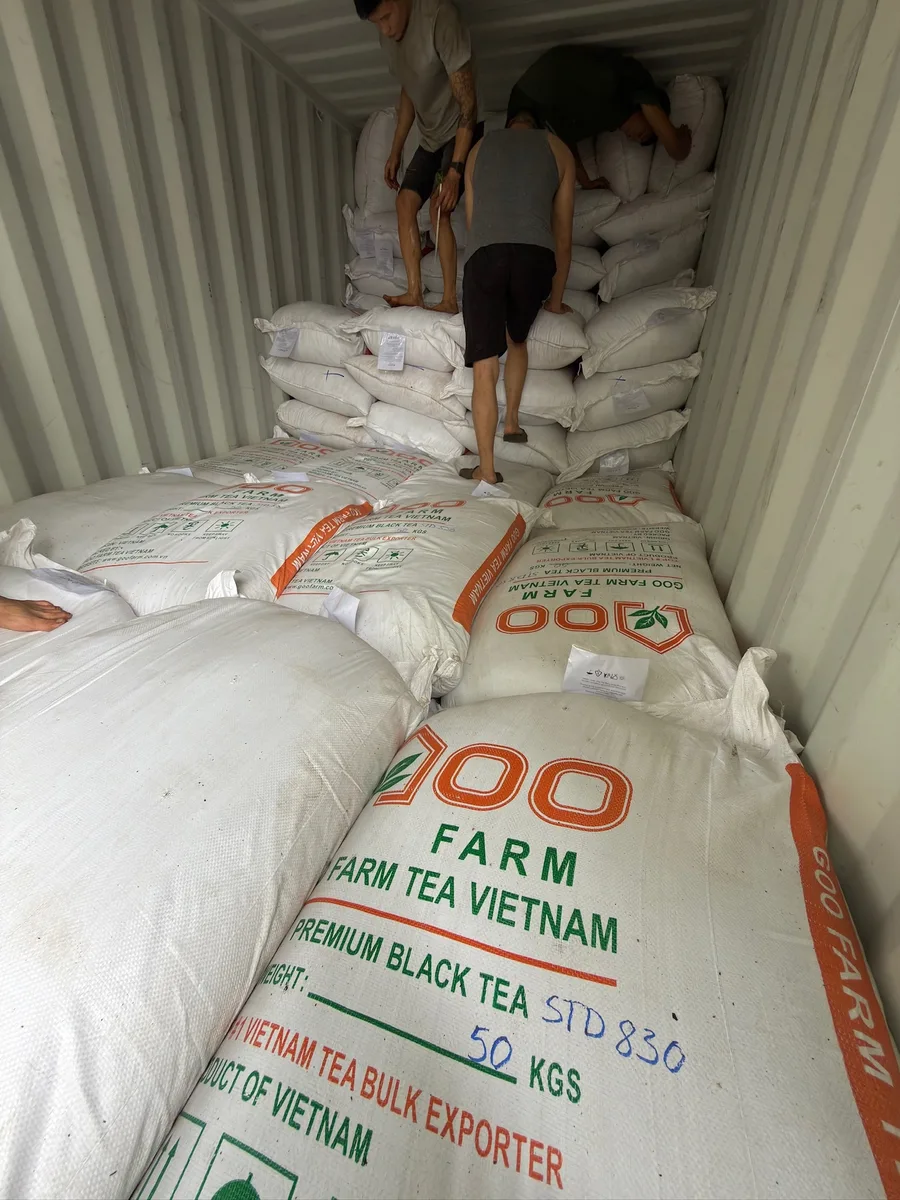
Why Vietnamese tea sells below the world average price, and what that means for buyers
Vietnam's average export price is about 55–67% of the world average, depending on the source and year. VnExpress put the world average export price at about $2,600 per ton in 2023, a year in which Vietnam averaged $1,738. MOIT's Import-Export Department put Vietnam's price at about 65% of the world average (Mekong ASEAN, March 2025), and Báo Chính phủ, the government newspaper, at 55–65%. For comparison, the FAO Tea Composite Price, an index of black tea auction prices, averaged $2.54 per kg in 2023 (FAO).
The sources give four reasons:
- Bulk exports. Most of Vietnam's exported tea is in raw form, according to the Ministry of Agriculture's assessment reported by VnExpress.
- Fragmented raw material. Only about 10% of factories have their own growing areas or close links with growers, so the quality of the incoming leaf is uneven (Báo Chính phủ).
- Efficiency and quality. FAO lists "low production efficiency and lower quality" among the issues that affect Vietnam's prices and export earnings.
- A low-price image. Hoàng Vĩnh Long, chairman of the Vietnam Tea Association (Vitas), said the world sees Vietnam's tea market as "a low-price market" (Công Thương, August 2025, translated).
The same Công Thương report quotes Nguyễn Văn Toàn, former director of the Northern Mountainous Agriculture and Forestry Science Institute: Vietnamese tea averages $1.75 per kg for export but about $7.50 per kg in the domestic market.
For buyers this means:
- Cost. Vietnam supplies blending and tea bag grades well below the world average price.
- Compare like with like. The national average hides a wide range of grades, so compare offers on the same specification and an approved sample.
- Documents. Ask for a specification sheet, food safety certificates and test results with the sample.
- Firmer prices. The average export price in January–August 2026 was 9.2% higher than a year earlier.
What Vietnam exports: black, green, CTC and tea dust
The HS code used in trade statistics, 0902, splits tea only into green and black: partly fermented tea such as oolong is counted with black tea, and orthodox, CTC, fannings and dust grades are not separated. In the breakdowns available, black and green tea are close in volume, and green tea earns more per ton:
- In January–May 2025, black tea exports were 22,800 tons worth $29.7 million and green tea 21,600 tons worth $40.3 million; together they made up 95.4% of the volume (Công Thương, July 2025, citing MOIT data). That is about $1,300 per ton for black tea and $1,870 for green (calculated).
- In 2023, Vietnam reported to UN Comtrade 51,111 tons of bulk black tea worth $71.9 million and 53,859 tons of bulk green tea worth $105.9 million. Pakistan took 71% of the bulk green tea; the largest buyers of bulk black tea by volume were Taiwan, Russia, Iraq, the United States and Indonesia (WITS black tea, WITS green tea).
Black tea once made up 60–70% of Vietnam's tea exports before green tea caught up, according to Nguyễn Văn Toàn in the Công Thương report. Some press reports say green tea is 94% of export volume (VnExpress, January 2024); the customs and Comtrade breakdowns above do not support that figure, so we use them instead.
Our buying guides cover each type:
- Orthodox black tea, rolled-leaf grades from OPA to fannings: Vietnam orthodox black tea.
- CTC black tea, granules for tea bags, chai and milk tea: Vietnam CTC black tea.
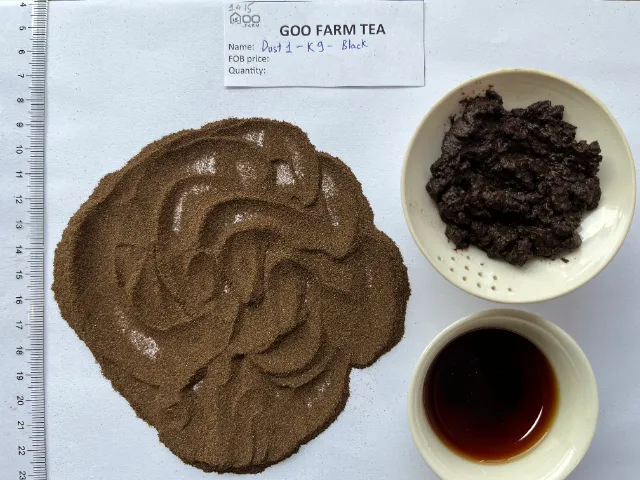
- Tea dust and fannings for tea bags, milk tea and extract: Vietnam tea dust.
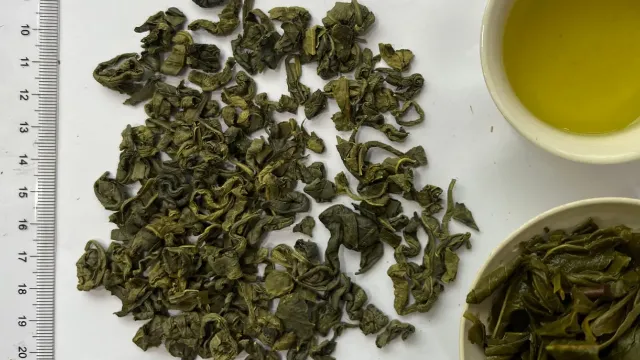
- Green tea: Vietnamese green tea grades, BOM green tea and our green tea range.
- Oolong: Vietnam oolong tea.
Growing regions and production
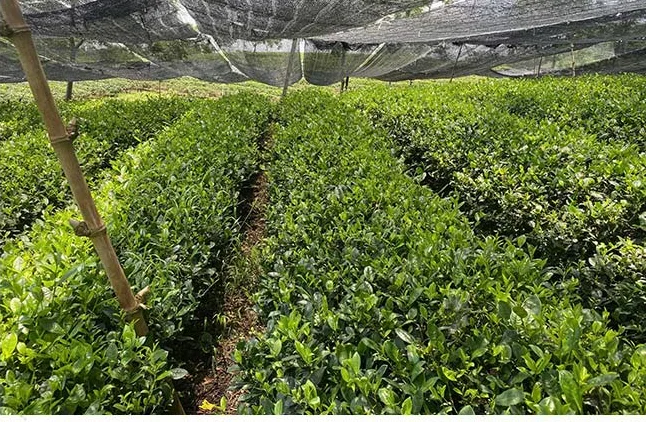
Vietnam had about 121,900 hectares of tea in 2024, down from a peak of 133,600 ha in 2015, while fresh leaf output roughly doubled from 570,000 tons in 2005 to 1.154 million tons in 2024, thanks to new varieties, now on about 54% of the area, and better growing practices (Báo Chính phủ). Other estimates of the area run up to 128,000 ha (VnEconomy, February 2026). In 2025 output reached 1,161,400 tons of fresh leaf (National Statistics Office). Dry tea output is put at 190,000–214,000 tons a year (PSAV, an MAE partnership; VnEconomy), and the domestic market takes about 45,000–50,000 tons worth some $320 million (PSAV), so most of the crop is exported.
Tea grows mainly in the northern midlands and mountains, with a second area in Lam Dong, in the Central Highlands. Provinces merged on 1 July 2025: Yen Bai is now part of Lao Cai, and Ha Giang, known for its Shan tuyet tea, is now part of Tuyen Quang.
| Province (since July 2025) | Tea area | Fresh leaf output | Источник |
|---|---|---|---|
| Thai Nguyen | more than 22,000 ha | more than 265,000 tons a year | VietnamPlus, April 2026 |
| Phu Tho | about 14,500 ha, 4th by area | more than 193,000 tons a year, 2nd | VTV, August 2026 |
| Lao Cai, incl. former Yen Bai | more than 15,000 ha | more than 122,300 tons in Jan–Sep 2026 | Báo Lào Cai, September 2026 |
Other important tea provinces include Tuyen Quang, Son La (Moc Chau), Lam Dong and Nghe An. Our own factories are in two of these provinces, Phu Tho and Yen Bai (now Lao Cai).
Outlook 2026–2030
The government's plan is Decision 431/QĐ-BNN-TT of 26 January 2024, the programme for key industrial crops to 2030 (LuatVietnam). For tea it sets:
- Area: about 120,000–125,000 ha by 2030, of which 98,000–100,000 ha in the northern midlands and mountains, 10,000–12,000 ha in the North Central region and 8,000–10,000 ha in the Central Highlands.
- Output: 1.2–1.4 million tons of fresh leaf.
- Standards: more than 70% of the area under GAP or equivalent standards, and more than 70% with registered growing-area codes.
- Products: a 50:50 mix of green and black tea.
Some press reports attribute higher targets to the same programme: 130,000–135,000 ha, 1.4–1.5 million tons of fresh leaf and $280–300 million of exports (Công Thương, August 2025). These figures do not appear in the decision text we checked, so we use the decision.
In the 2026 data, volume is falling while prices rise, a pattern Vinanet expects to continue, and demand is spreading from Pakistan toward Russia, the United States, Saudi Arabia and Europe. Over the medium term, FAO expects the world green tea market to grow faster than black tea, driven mainly by China's domestic market. We will update this page as new customs data is published.
Часто задаваемые вопросы
How much tea does Vietnam export a year? Between about 120,000 and 146,000 tons a year in 2020–2025. In 2025 it exported 136,952 tons worth $237.9 million, according to Vietnam Customs.
What is the average price of Vietnamese export tea? $1,737 per ton in 2025 and $1,857 per ton in January–August 2026, calculated from customs data. Depending on the source and year, that is about 55–67% of the world average export price.
Which country buys the most tea from Vietnam? Pakistan: 41,337 tons worth $79.5 million in 2025, 30% of the volume. Part of this tea goes on to Afghanistan in transit through Karachi.
Does Vietnam export more black tea or green tea? Roughly equal amounts by volume, but green tea earns more per ton. In January–May 2025, black tea exports were 22,800 tons and green tea exports 21,600 tons.
Is Vietnam a major tea exporter? Yes. It is the world's fifth-largest tea exporter (VietnamPlus). World tea exports totaled 1.84 million tons in 2022, according to FAO.
Where is tea grown in Vietnam? Mainly in the northern midlands and mountains (Thai Nguyen, Phu Tho, Lao Cai, Tuyen Quang and Son La) and in Lam Dong in the Central Highlands, on about 122,000 ha in total.
Запросите образцы и коммерческое предложение
Goo Farm Tea Vietnam is a tea manufacturer and exporter with factories in Phu Tho and Yen Bai. The Yen Bai factory is ISO 22000:2018 certified by Vinacontrol (certificate No. 31905-FSV). We supply 46 grades across six categories and export to more than 30 countries in the CIS, the Middle East, Southeast Asia and Africa. Tell us the grades, quantity, packing and destination you need, and we will reply with samples and a quotation. Contact us.
Источники
- Vietnam Customs (Ministry of Finance), Exports by main commodity (Xuất khẩu hàng hóa theo tháng): December 2021, final, printed 22 April 2022; December 2022, 9 January 2023; December 2023, 9 January 2024; December 2024, 6 January 2025; December 2025, 5 January 2026; August 2026, 3 September 2026.
- Vietnam Customs, Exports by country and main commodity (Xuất khẩu nước/vùng lãnh thổ – mặt hàng chủ yếu): December 2024, August 2025, December 2025, August 2026.
- agro.gov.vn, Xuất khẩu chè năm 2020 giảm cả lượng và kim ngạch, 1 February 2021.
- VTV, Xuất khẩu nông, lâm, thủy sản 9 tháng tăng 7,8%, October 2026 (MAE data).
- Vinanet (MOIT), Xuất khẩu chè Việt Nam: Sụt giảm về lượng, bứt phá nhờ đòn bẩy giá, 19 September 2026.
- Công Thương, Bộ Công Thương khẩn trương tháo gỡ 500 container chè ách tắc tại Pakistan, 25 декабря 2025 г.
- Vietnam News, Pakistan allows re-export of nearly 500 tea containers of Việt Nam stranded at Karachi Port, 31 декабря 2025 г.
- VnExpress, Xuất khẩu chè Việt Nam thấp nhất 7 năm, 14 January 2024.
- Mekong ASEAN, Giá chè xuất khẩu của Việt Nam chỉ bằng khoảng 65% so với thế giới, 16 March 2025.
- Báo Chính phủ, Xuất khẩu chè: Nâng chuẩn chất lượng, kiến tạo giá trị, 28 February 2026.
- FAO, Current global market situation and medium-term outlook, CCP:TE/24/2, January 2024.
- Công Thương, Lý do chè Việt xuất khẩu vẫn mắc kẹt ở phân khúc giá rẻ, 11 August 2025.
- Công Thương, Xuất khẩu chè Việt Nam kỳ vọng phục hồi trong nửa cuối năm 2025, 10 July 2025.
- World Bank WITS (UN Comtrade data), Viet Nam exports of black tea, HS 090240 and green tea, HS 090220, 2023 data, accessed 4 October 2026.
- VietnamPlus, Vietnam ranks fifth in the world in tea exports, 6 November 2024.
- National Statistics Office, Press release on the socio-economic situation in the fourth quarter and 2025, 5 January 2026.
- PSAV (Partnership for Sustainable Agriculture in Vietnam, MAE), Chè, accessed 4 October 2026.
- VnEconomy, Xuất khẩu chè: Từ áp lực sụt giảm đến cơ hội tái định vị giá trị năm 2026, 11 February 2026.
- LuatVietnam, Quyết định 431/QĐ-BNN-TT 2024 Đề án phát triển cây công nghiệp chủ lực, decision of 26 January 2024.
- VietnamPlus, Chè Thái Nguyên khẳng định vị thế cây trồng chủ lực, hướng tới mục tiêu tỷ USD, 28 April 2026.
- VTV, Phú Thọ: Khẳng định giá trị thương hiệu cây chè Đất tổ, August 2026.
- Báo Lào Cai, Doanh thu từ cây chè đạt gần 795 tỷ đồng, 27 September 2026.