AR
 RU
 ZH
 UZ
 HI
 UR
 FA
 FR
 VI

Tea Importers in Afghanistan: Green Tea and Routes in 2026

In short: Afghanistan's green tea comes mainly from Vietnam, booked as exports to Pakistan: 38,054 tons in 2023 against 5,277 recorded by Pakistan. Karachi transit has largely stopped since October 2025; routes now run through Iran or Central Asia. Pay against documents, not after arrival.
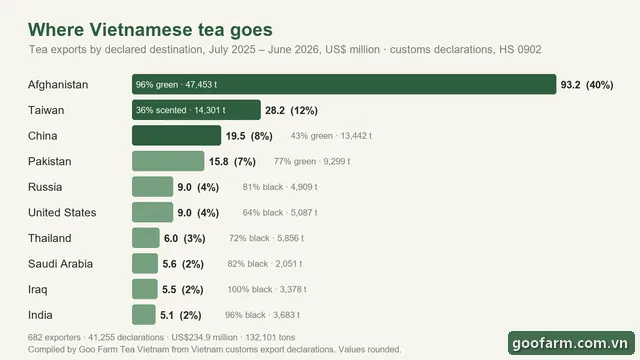
In December 2025 nearly 500 containers of Vietnamese tea sat in the port of Karachi, bought by Afghan traders and unable to cross a closed border. Most of them held green tea, and that is the heart of the trade: the Vietnam Tea Association says nearly all of Vietnam's green tea exports are drunk in Afghanistan. For tea importers in Afghanistan, the question in 2026 is less which tea to buy than how to bring it in. This guide covers both: what the trade data shows, which Vietnamese grades to sample, the routes through Pakistan, Iran and Central Asia, sanctions screening and the payment terms that protect both sides when a border closes.
Checked in October 2026 against UN Comtrade data, US Treasury guidance, World Bank and WFP reports and Pakistani and Vietnamese press. Border conditions change quickly: confirm the current route with your forwarder before every order.
What the numbers show
Afghanistan does not report its tea imports in detail to the UN, so the picture comes from its suppliers:
- Vietnam ships its green tea "to Pakistan" on paper. In 2023 Vietnam recorded 38,054 tons of green tea exported to Pakistan, while Pakistan recorded only 5,277 tons imported from Vietnam. Most of the gap, about 33,000 tons, fits tea that crossed Pakistan in transit to Afghanistan. Our reading of these figures is that Vietnam is Afghanistan's main source of green tea by a wide margin.
- Kenya supplies black tea: 4,041 tons of bulk black tea to Afghanistan in 2024, according to Kenya's own export data.
- China supplies some green tea: 751 tons in 2024.
Afghanistan has long been described as a green tea drinking country, with black tea drunk alongside it. The volumes above fit that picture.
Which Vietnamese green tea to sample
We have found no published data on the exact grades Afghan buyers prefer, and buyers' specifications differ by city and by price level. Sample across the range and compare in the cup:
| Grade | What it looks like | Indicative FOB Hai Phong, US$/kg | Tons / 40HC |
|---|---|---|---|
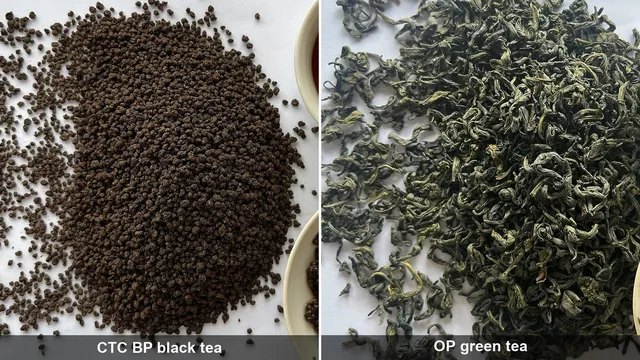
| OP green tea | Big, well-rolled leaf, bright yellow cup | 1.46–2.02 | 17 |
| Pekoe green tea | Bright green, well-rolled leaf, bright green cup | 1.28–2.30 | 18 |
| OPA green tea | Large, slightly open leaf | 1.09–2.52 | 14 |
| BOM green tea | Big, open curls, strong cup | 1.00–1.26 | 14 |
| Madina green tea | Tightly rolled, gunpowder style | 2.21–2.33 | 25 |
| Broken green tea | Small pieces, strong cup, lower price | 0.71–1.10 | 22 |
Indicative prices in October 2026; see our Vietnam tea prices page for the live list.
Leaf size changes the freight cost per kilogram as much as the price does: a 40HC carries about 14 tons of open-leaf OPA or BOM but about 25 tons of compact Madina. Our guide to Vietnamese green tea grades describes each grade, and BOM green tea has its own buying guide.

The routes in 2026
Through Karachi: closed to trade since October 2025
For years most Vietnamese tea reached Afghanistan in transit through Karachi under the Afghanistan–Pakistan transit trade agreement. Two changes ended that:
- October 2023: Pakistan removed black tea, among other goods, from the items allowed in Afghan transit, to curb smuggling. Green tea stayed allowed.
- October 2025: the border closed to trade after clashes. Nearly 500 containers of Vietnamese tea were stranded until Pakistan allowed their re-export to other ports on 31 December 2025. Transit trade through Pakistan fell to 11,592 containers in fiscal 2025-26, from 42,959 the year before.
Torkham reopened at the end of March 2026 for the return of Afghan refugees; we have no confirmation that commercial transit has resumed. Do not plan a shipment on this route without your forwarder's written confirmation that it is open.
Through Iran: the main corridor, now under strain
The World Bank counts Iran as the backbone of Afghanistan's imports: in fiscal 2025, 48.6% of Afghan imports came from or through Iran, via Bandar Abbas and Chabahar. Since the war that began at the end of February 2026, shipping in the Gulf has been severely disrupted, and the World Food Programme reported in March 2026 that imports through the Iranian corridor had dropped sharply.
Through Central Asia
Routes through Uzbekistan and Turkmenistan are gaining importance, according to the World Bank, though they are longer for tea from Southeast Asia. Ask your forwarder to compare them with the Iranian corridor on cost, time and risk.
Sanctions screening
Trading tea with Afghanistan is legal. The US Treasury states that no US sanctions prohibit exporting goods to Afghanistan, as long as no sanctioned person or entity is involved, and a general licence allows payment of Afghan taxes, fees and import duties. The UN sanctions regime targets listed individuals and groups, not trade in general.
In practice, before each new contract:
- Screen the buyer, the consignee and the bank against the UN 1988 sanctions list and the US SDN list.
- Keep the contract, invoice and transport documents complete, because banks along the payment chain will ask for them.
This is general information, not legal advice.
Payment terms after the Karachi crisis
Many of the containers stranded in Karachi had been sold on payment after arrival or after customs clearance in Afghanistan. When the border closed, the exporters waited months for their money and the buyers for their tea. The lesson for both sides:
- Agree terms that do not depend on the border: a letter of credit, cash against documents through a bank, or an advance with the balance against the bill of lading.
- Name the port of discharge and the transit route in the contract, and state who pays storage, demurrage and rerouting if a border closes.
- Ship FOB or CFR to the port of discharge, and buy the onward leg from a forwarder who works the route every week.
Frequently asked questions
Where does Afghanistan import tea from? Green tea comes mainly from Vietnam, much of it booked in Vietnamese statistics as exports to Pakistan, with smaller amounts from China. Black tea comes mainly from Kenya.
Can Vietnamese tea still reach Afghanistan through Karachi? Transit trade through Pakistan has been largely stopped since the border closure of October 2025, and black tea has been barred from Afghan transit since 2023. Check the current status with your forwarder.
Is it legal to sell tea to Afghanistan? Yes. The US Treasury says no US sanctions prohibit exporting goods to Afghanistan, provided no sanctioned person or entity is involved. Screen every party before you sign.
Which green tea grades do Afghan buyers use? Specifications vary. We suggest sampling OP, Pekoe, OPA, BOM and Madina side by side and choosing by cup, leaf and landed price.
How should I pay for tea shipped to Afghanistan? On terms that release payment against shipping documents, such as a letter of credit or cash against documents, rather than payment after arrival in Afghanistan.
Request samples for the Afghan market
Goo Farm Tea Vietnam makes green tea and orthodox and CTC black tea at factories in Phu Tho and Yen Bai; the Yen Bai factory is ISO 22000:2018 certified. Tell us the grades you buy today, your planned route and the quantity, and we will send samples with an indicative quotation. Contact us.
Sources
- World Bank WITS (UN Comtrade data): Viet Nam's green tea exports, 2023; Pakistan's green tea imports, 2023; Kenya's black tea exports, 2024; China's green tea exports, 2024, accessed 28 October 2026.
- Thuong hieu & Cong luan, report on Vietnamese tea containers stranded in Pakistan, 22 December 2025, quoting the Vietnam Tea Association.
- Vietnam News, Pakistan allows re-export of nearly 500 tea containers of Viet Nam stranded at Karachi Port, 31 December 2025.
- Business Recorder, report on the Afghan transit ban list, 5 October 2023.
- Outlook Business, Afghan-Pak transit trade plunges to $367 million, 19 July 2026.
- Profit, Pakistan reopens Torkham border for Afghan repatriation, 31 March 2026.
- IANS, Afghanistan's new trade routes, 25 August 2026, citing the World Bank.
- World Food Programme, Afghanistan Weekly Market Report No. 288, as republished, 26 March 2026.
- Dawn, report describing Afghanistan as a green tea consuming country, 2003.
- US Treasury OFAC, fact sheet on humanitarian assistance and support to the Afghan people, 13 April 2022, and the Afghanistan-related sanctions programme.