AR
 RU
 ZH
 UZ
 HI
 UR
 FA
 FR
 VI

Vietnam Spring Tea 2025: Did Production Really Drop?

Vietnam's spring tea crop did not fall in 2025, at least not nationally. Fresh tea leaf output rose 2.9% in both January–March and January–June 2025, according to the National Statistics Office (NSO). The losses were local: a dry winter after Typhoon Yagi held back the first picking in parts of Thai Nguyen until rain came in late February. In 2026, output is up again, but fresh leaf prices fell because of problems in export markets.
Last updated 4 October 2026, with official statistics to September 2026.
What spring tea is and why buyers care
Spring tea, chè xuân in Vietnamese, is the first new growth after the winter rest, when many growers in northern Vietnam prune their bushes. Midland gardens are picked first: in 2025, one family in Thai Nguyen had already picked twice by early March (Báo Thái Nguyên). Mountain gardens follow: in Ban Lien, Lao Cai, the season runs from mid-March to the end of April (Báo Lào Cai).

Buyers care for three reasons:
- Taste. A 2020 study of tea leaves from Henan, China, found significantly more theanine in spring than in summer or autumn, and more catechins in summer (Gong et al.). Theanine gives a sweet, savory taste. Catechins cause an estimated 70–75% of the bitterness and astringency of green tea.
- Price. In Thai Nguyen in early March 2025, spring green tea made by farm households sold for 300,000–350,000 Vietnamese dong (VND) per kg, against an expected 150,000–200,000 VND for the main crop that follows (Báo Thái Nguyên). That is a domestic specialty price; export grades are priced per grade and contract.
- Volume. The early crop is small. Vietnam harvested 178,300 tons of fresh leaf in January–March 2025, against 416,200 tons in July–September (NSO data; the second figure is our calculation).
What happened in spring 2025
A dry winter
After Typhoon Yagi in September 2024, Thai Nguyen had a long period without rain, Báo Thái Nguyên reported on 17 February 2025. Pruned bushes were slow to put out new shoots, and some tea dried out. One cooperative put its early spring output 60–70% below a normal year; another said its yields were down by more than half on 2024. The dry spell was wide: in January, the Department of Water Resources reported almost no rain across the North (Báo Đầu tư).
Rain in late February
By 4 March 2025, Thai Nguyen had had nearly a month of drizzle and high humidity, and Báo Thái Nguyên reported a good spring harvest at good prices. In Moc Chau, Son La, the harvest was in progress in late April, with Vinatea Moc Chau expecting 650–700 tons of fresh leaf and no shortfall reported (Dân tộc & Miền núi).
The national figures
The NSO credited favorable weather for good perennial crop harvests in the first quarter of 2025. Growth slowed only late in the year: 0.6% for the full year, after 3.3% for the first nine months.
| Period | 2025 output (tons) | Change on 2024 | 2026 output (tons) | Change on 2025 |
|---|---|---|---|---|
| January–March | 178,300 | +2.9% | 187,700 | +4.2% |
| January–June | 546,600 | +2.9% | 566,000 | +4.0% |
| January–September | 962,800 | +3.3% | 990,100 | +5.1% |
| Full year | 1,161,400 | +0.6% | not yet published |
Source: NSO releases of 6 April 2025, 5 July 2025, 6 October 2025, 5 January 2026, 3 April 2026, 3 July 2026 and 3 October 2026. Output is fresh tea leaf; changes are year on year.
We found no official report of an unusual pest outbreak in spring 2025, and no published spring figures for Phu Tho or Yen Bai. The evidence shows local losses and a quick recovery, not a national fall.
What it meant for prices and availability
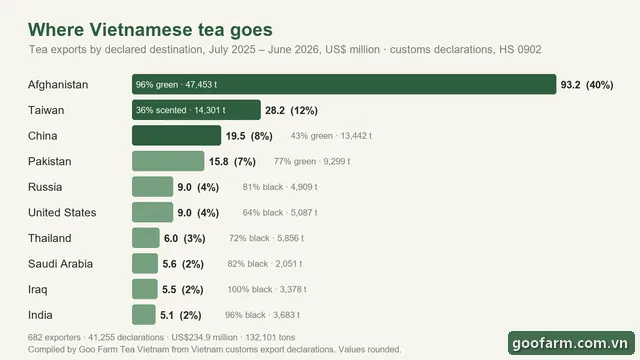
Export prices did not rise after the spring crop. In January–June 2025, the average export price, $1,666.6 per ton, was 2.5% lower than a year earlier (Vitas, citing customs data). For the full year, exports fell 7.1% in volume to 136,952 tons, worth $237.9 million (Vietnam Customs, 2025 and 2024).
For farmers, spring 2025 was the better season: two April 2026 reports from Lao Cai put spring 2026 leaf prices 1,000–1,500 VND per kg lower (Báo Lào Cai; Dân Việt).
The biggest disruption of 2025 came late in the year, not in spring. Nearly 500 containers of Vietnamese tea, mostly sold to Afghanistan, were stranded at Karachi after Pakistan tightened transit controls (Công Thương). On 31 December, Pakistan allowed their re-export (Vietnam News).
In general, drought in early spring hurts the first, finest pickings most, and bulk grades from the larger summer crop much less. That fits 2025: specialty spring tea sold high, while the export price did not rise.
What 2026 shows so far
More leaf. Output rose 4.2% in January–March 2026 and 5.1% in January–September, to 990,100 tons (NSO). Phu Tho's statistics office called first-quarter weather relatively favorable (Thống kê Phú Thọ).
Lower farm prices. In Lao Cai, which since July 2025 includes the former Yen Bai province, fresh leaf sold for 6,000–7,000 VND per kg in spring 2026, and about 4,000 VND before factories restarted in mid-March. Báo Lào Cai linked the fall to conflict in the Middle East, which disrupted shipping and raised logistics costs five to six times. Farmers also reported higher fertilizer and pesticide costs (Báo Lào Cai).
Fewer export tons, higher prices. In January–August 2026, exports fell 9.8% to 77,256 tons, while the average price rose 9.2% to $1,857 per ton. Shipments to Pakistan fell 60.8%, to 11,902 tons (Vietnam Customs; Vinanet).
Summer heat. Nearly two months of intense heat had cut yields by more than half in some Nghe An gardens by July (Báo Nghệ An).
For export volumes by market, see our report on Vietnam tea exports; for indicative FOB prices by grade, see Vietnam tea prices.
How buyers can plan around the seasons
- Decide whether you need spring leaf. For tea bags, blends and milk tea, grade matters more than picking month.
- Book spring lots early. Ask for new-crop samples in March and April, and confirm quantities soon after approval.
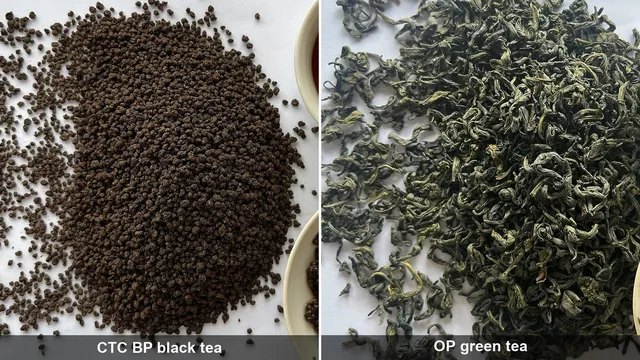
- Write the specification down. Grade, leaf appearance, liquor color, moisture and, for fannings and dust, particle size. The approved sample becomes the standard for the order.
- Blend seasons. Combining spring and summer lots of one grade keeps the cup steady through the year.
- Check before loading. Compare a pre-shipment sample with your reference sample.
- Watch freight, not only weather. Lao Cai's 2026 price fall was linked to shipping and export markets, not the harvest.
How our factories handle seasonal variation
Goo Farm Tea Vietnam makes tea in Phu Tho and in Yen Bai, now part of Lao Cai province. Leaf changes from one picking to the next, so each lot is sorted and graded after processing. Our standard does not change with the season: every order must be the same as or better than the sample you approved. The Yen Bai factory is certified to ISO 22000:2018 by Vinacontrol (certificate No. 31905-FSV).
Frequently asked questions
What is spring tea? The first new shoots a tea bush grows after its winter rest. In northern Vietnam it is picked from about February in the midlands to April in the mountains.
Did Vietnam's spring tea production drop in 2025? Not nationally. Fresh leaf output rose 2.9% in both January–March and January–June 2025 (NSO). Drought cut early picking in parts of Thai Nguyen until late February.
Is spring tea more expensive? Specialty spring green tea is: 300,000–350,000 VND per kg in Thai Nguyen in March 2025, against an expected 150,000–200,000 VND for the main crop. Export grades are priced per grade and contract.
How does 2026 compare? Output is up 5.1% for January–September, but spring leaf prices in Lao Cai were 1,000–1,500 VND per kg lower than in 2025.
Request samples and a quotation
Tell us the grade, quantity, packing and destination, and whether you need spring leaf, and we will reply with samples and a quotation. See our green tea and orthodox black tea grades, our wholesale tea range, or contact us.
Sources
- National Statistics Office (NSO), Press release on the socio-economic situation in the first quarter of 2025, 6 April 2025.
- NSO, Thông cáo báo chí về tình hình kinh tế - xã hội quý II và sáu tháng đầu năm 2025, 5 July 2025.
- NSO, Press release on the socio-economic situation in the third quarter and nine months of 2025, 6 October 2025.
- NSO, Press release on the socio-economic situation in the fourth quarter and 2025, 5 January 2026.
- NSO, Press release on the socio-economic situation in the first quarter of 2026, 3 April 2026.
- NSO, Thông cáo báo chí về tình hình kinh tế - xã hội quý II và sáu tháng đầu năm 2026, 3 July 2026.
- NSO, Thông cáo báo chí tình hình kinh tế - xã hội quý III và 9 tháng năm 2026, 3 October 2026.
- Báo Thái Nguyên, Thời tiết khắc nghiệt, người trồng chè gặp khó, 17 February 2025.
- Báo Thái Nguyên, Chè xuân được mùa, được giá, 4 March 2025.
- Báo Đầu tư, Miền Bắc ít mưa khiến lấy nước nông nghiệp đợt 1 năm 2025 chưa được tốt, 20 January 2025.
- Dân tộc & Miền núi (Báo Tin tức, VNA), Cao nguyên Mộc Châu vào vụ chè xuân, 27 April 2025.
- Báo Lào Cai, Bản Liền vào vụ chè xuân, 8 April 2026.
- Báo Lào Cai, Cần tái cấu trúc ngành chè trước biến động thị trường xuất khẩu, 3 April 2026.
- Dân Việt, Giá chè búp tươi giảm do điều này, nông dân tỉnh Lào Cai vẫn lên đồi chăm tay bẻ, 13 April 2026.
- Thống kê tỉnh Phú Thọ (NSO), Báo cáo tình hình kinh tế - xã hội tỉnh Phú Thọ quý I năm 2026, 8 April 2026.
- Báo Nghệ An, Nắng hạn kéo dài, nhiều diện tích chè nguyên liệu khô cháy, 10 July 2026.
- Vitas (Vietnam Tea Association), Xuất khẩu chè Việt Nam 06 tháng 2025, 23 July 2025.
- Vietnam Customs, Exports by main commodity: December 2024, 6 January 2025; December 2025, 5 January 2026; August 2026, 3 September 2026.
- Vinanet (Ministry of Industry and Trade), Xuất khẩu chè Việt Nam: Sụt giảm về lượng, bứt phá nhờ đòn bẩy giá, 19 September 2026.
- Công Thương, Bộ Công Thương khẩn trương tháo gỡ 500 container chè ách tắc tại Pakistan, 25 December 2025.
- Vietnam News, Pakistan allows re-export of nearly 500 tea containers of Việt Nam stranded at Karachi Port, 31 December 2025.
- Gong A-D, Lian S-B, Wu N-N and others, Integrated transcriptomics and metabolomics analysis of catechins, caffeine and theanine biosynthesis in tea plant over the course of seasons, BMC Plant Biology 20, 294, 2020.