AR
 RU
 ZH
 UZ
 HI
 UR
 FA
 FR
 VI

Vietnamese vs Chinese Tea Culture: Teas, Brewing and Rituals

Vietnamese and Chinese tea culture grow from the same plant, but they have taken different paths. China built a culture of many tea categories, famous named teas and refined brewing arts. Vietnam's is simpler and greener. Guests get a fresh pot of green tea, villages brew fresh leaves, flowers scent the tea and street stalls serve it iced. In trade, China drinks most of its own tea, while Vietnam exports most of its crop, largely in bulk.
Shared roots, different paths
The tea plant grows naturally from northeast India through China and south into Vietnam (Britannica). In China, tea began as a medicine made by boiling fresh leaves and became a daily drink around the 3rd century CE (Britannica). In the 8th century, Lu Yu wrote The Classic of Tea (Cha Jing). Under the Tang, ground tea was boiled in a pot. Under the Song, tea powder was whisked in a bowl. Under the Ming and Qing, loose leaves were steeped in very hot water (National Palace Museum).
In Vietnam, 1,324 ancient Snow Shan tea trees in Ha Giang province were named heritage trees in 2022 (VietnamPlus). Under French rule, research stations opened in 1917–1918 at Phu Ho in Phu Tho and at Pleiku to improve tea growing (Tessier, Annales). Writers at Vietnam News call Vietnamese tea art rustic, without the many rules of Japanese tea or the rich history of Chinese tea.
What Vietnam and China drink
China's range is much wider. UNESCO, which listed China's traditional tea processing as intangible heritage in 2022, counts six categories: green, yellow, dark, white, oolong and black. With scented teas, that makes over 2,000 products. Green tea is still the largest, at 59% of China's output in 2025, ahead of black tea (16%), dark tea (12%) and oolong (10%) (China Tea Marketing Association). Famous teas are tied to places: Longjing (Dragon Well) from Hangzhou's West Lake, Pu-erh from Yunnan and jasmine tea from Fujian (China Daily). Anxi in Fujian is known for Tieguanyin (FAO).
Vietnam's range is narrower. The home market is mostly green tea, according to VIOIT, the trade ministry's research institute. Country families also pick fresh leaves from the garden and brew a big pot (Nhân Dân), close to China's oldest way of drinking tea. Green tea is scented with flowers, too. A kilogram of Hanoi's West Lake lotus tea can take up to 1,200 flowers (Vietnam News). In Ho Chi Minh City, street iced tea is often brewed from jasmine green tea (Saigoneer). Famous names include Tan Cuong green tea from Thai Nguyen (Vietnam News) and Snow Shan from the northern mountains.
How each culture brews tea
In Vietnam, a visit starts with the host rinsing the pot and brewing fresh tea (Nhân Dân). Tea is also set out on meeting tables (Báo Cao Bằng). In Hanoi, sidewalk stalls pour strong dried tea over ice, often with peanut candy (VnExpress International).
A famous Chinese brewing style is gongfu cha ("tea made with effort") from Fujian and Guangdong (National Palace Museum). In Chaozhou, where it became national intangible heritage in 2008, the teapot fits in a palm and each cup is smaller than a table tennis ball. Dancong oolong is a local favorite, and the host moves the pot around the cups to pour evenly (China Daily). In daily life, tea is steeped or boiled in homes, workplaces, teahouses and temples (UNESCO).

Water and teaware
Both traditions take water seriously. A Vietnamese saying lists the keys to good tea: nhất nước, nhì trà, tam pha, tứ ấm, meaning "first water, second tea, third brewing, fourth pot" (Vietnam News). In China, Lu Yu ranked mountain spring water best, river water second and well water last (Cha Jing, chapter 5).
A classic Vietnamese tea set has four small cups and one sharing cup, the chén tống (Nhân Dân). In China, the switch to steeping led to the teapot, often credited to 16th-century potters in Yixing (The Met). The gaiwan, a lidded bowl, is designed to steep, strain and keep tea hot at once (Spencer Museum of Art).
Tea in rituals and social life
In both countries, tea welcomes guests. A tea connoisseur told Vietnam News that receiving a guest begins with making tea. UNESCO describes the same custom among China's many ethnic groups.
The rites differ. Vietnamese families honor their ancestors with rounds of tea and rice wine (Nhân Dân). Tea is a must at Tết (Lunar New Year) and on death anniversaries (Báo Cao Bằng). At a northern engagement, tea is one of the gift trays, but the tray that cannot be missing is betel and areca (Ngôi Sao). In a Chinese wedding, tea is the rite itself. The bride and groom kneel and serve tea to elders of both families to show gratitude and respect (South China Morning Post).
Vietnamese vs Chinese tea culture at a glance
| Aspect | Vietnam | China |
|---|---|---|
| Everyday tea | Green tea, hot or iced; fresh leaves in villages | Green tea first, but all six categories are drunk |
| Famous teas | Tan Cuong, Snow Shan, lotus tea | Longjing, Pu-erh, Tieguanyin, Dancong |
| Brewing | Pot, four small cups and a sharing cup | Gongfu set or gaiwan; tea is also boiled |
| Rituals | Tea for guests, ancestors and Tết | Tea for guests; couples serve elders at weddings |
| Trade | Exports most of its tea, largely in bulk | Drinks most of its tea; 88% of exports are green |
What the differences mean for tea buyers
China grows almost half of the world's tea and is the largest consumer. It drank 3 million tons in 2022, or 46% of the world total (FAO). In 2025 it exported 418,800 tons, 88% of it green tea, at an average of US$3.69 per kg (China Tea Marketing Association). That is about 11.5% of the 3.64 million tons China produced (CTMA; our calculation).
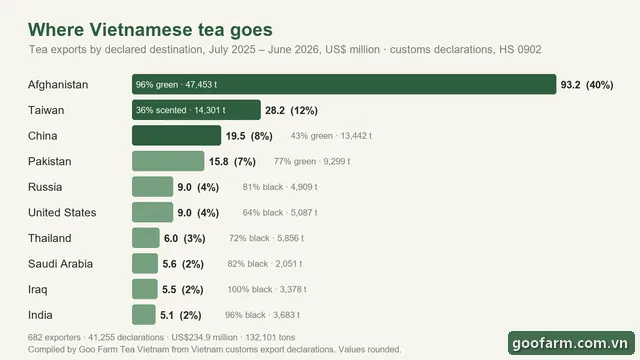
Vietnam is the opposite. It makes 190,000–200,000 tons of dry tea a year but drinks only 45,000–50,000 tons (PSAV). In 2025 it exported 136,952 tons worth nearly US$238 million (Công Thương), about US$1.74 per kg by our calculation. The same report puts Vietnam's average export price at only 55–65% of the world average. About 90% of exports leave in bulk and are sold under importers' brands (VIOIT). The top buyers are Pakistan, Taiwan and China itself (VietnamPlus). Black tea shows the pattern best: in 2022 Vietnam made 80,000 tons, exported 60,000 and drank about 3,000 (FAO).
For buyers, this means:
- Blends, tea bags, iced tea and extracts: Vietnam is a cost-effective source of black and green tea in standard export grades.
- Named Chinese teas: Longjing, Pu-erh and Tieguanyin are tied to their home regions in China.
- Vietnamese specialties: Tan Cuong green tea and Snow Shan suit buyers who want a named origin rather than a blending grade.
Frequently asked questions
Is Vietnamese tea the same as Chinese tea? Both come from the same plant, Camellia sinensis, which is native to both countries. The habits differ: Vietnam drinks mostly green tea and exports most of its black tea, while China makes six categories.
Does Vietnam have a tea ceremony like China? Vietnamese tea etiquette is less formal and centers on hospitality. China has codified brewing arts such as Chaozhou gongfu tea, a national intangible heritage.
What is the most popular tea in Vietnam and China? Green tea in both. It dominates Vietnam's home market and made up 59% of China's output in 2025.
What is gongfu tea? A Chinese brewing style from Fujian and Guangdong. It uses a palm-sized teapot and tiny cups, usually with oolong tea.
Why is Vietnamese tea cheaper than Chinese tea? Most Vietnamese exports are bulk grades sold under importers' brands. In 2025 they averaged about US$1.74 per kg, against US$3.69 for China.
Explore Vietnamese tea
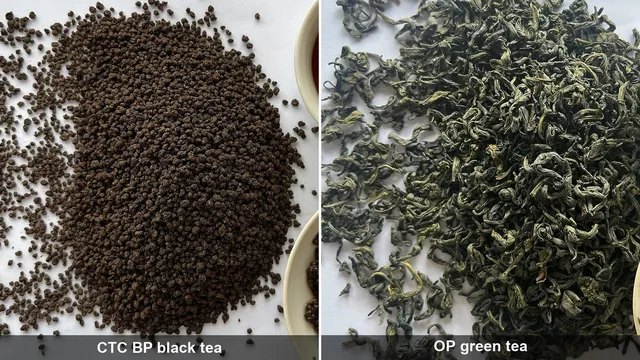
For everyday tea habits in Vietnam, read our guide to Vietnamese tea culture. Goo Farm Tea Vietnam makes green and black tea for export: browse our green tea, orthodox black tea and CTC black tea, or see how Vietnamese green tea grades differ.