AR
 RU
 ZH
 UZ
 HI
 UR
 FA
 FR
 VI

Vietnamese Tea Culture: Green Tea at Home, Black for Export

Vietnamese tea culture is, above all, a green tea culture. Green tea is the everyday drink: hot in small cups in the north, brewed from fresh leaves in the central provinces and poured over ice in the south. The country drinks about 45,000–50,000 tons of tea a year, roughly a quarter of the dry tea it makes, according to PSAV, a partnership under the Ministry of Agriculture and Environment (MAE). Black tea is different. Vietnam makes it mainly for export, and at home it is drunk more in milk tea than from the family teapot.
A pot of green tea for every guest
In Vietnam, hospitality starts with tea. Tea connoisseur Nguyễn Ngọc Tuấn told Vietnam News that welcoming a guest begins with making a cup of tea. When a visitor arrives, the host stops work, rinses the pot and brews it fresh (Nhân Dân). Village mornings often start with a pot of hot tea (Người Lao Động). At work, tea is set out at meetings and conferences (Báo Cao Bằng).
The pot usually holds plain green tea (Nhân Dân), which makes up most of the home market, according to VIOIT, the research institute of the Ministry of Industry and Trade.
Fresh-leaf tea, the countryside's everyday drink
Many rural families skip dried tea and brew chè tươi, also called chè xanh (fresh green tea), from just-picked leaves and twigs. Báo Tin Tức, a newspaper of the Vietnam News Agency, calls this a custom found only in Vietnam. Each region makes it differently:
- Hanoi: steeped in an ấm tích, a tall teapot kept warm in a padded basket.
- Nghe An: simmered in a pot for two to three hours.
- Ha Tinh: bruised and cooked in a clay pot.
- Hue: chopped, dried and boiled as needed.
It is traditionally drunk hot from earthenware bowls. In Nghe An, people rarely drink it alone. Villagers take turns cooking a pot and inviting the whole neighborhood, and at Tết (Lunar New Year) every household keeps one ready for guests (Người Lao Động).
Teas known by name: Thai Nguyen and Snow Shan
The most famous dried green tea comes from Tan Cuong in Thai Nguyen province, where it has been grown and hand-fired since the early 1900s. In 2023 this know-how was listed as national intangible heritage (Vietnam News). Drinkers value its ngọt hậu, the sweet finish that follows an astringent first sip.
Snow Shan tea is named for the white down on its buds. It is made from old tea trees in the northern highlands, in areas such as Yen Bai and Son La (VIOIT). Our Snow Shan Green Tea comes from old trees above 1,000 meters in the mountains of northern Vietnam.
Teas like these sell at home for $7–20 per kg, while the average export price is only about $1.7, said Hoàng Vĩnh Long, chairman of the Vietnam Tea Association (VnEconomy).
Scented teas: lotus and jasmine
Trà sen (lotus tea) is Hanoi's luxury tea, made around West Lake. Green tea is layered with the stamens of fresh lotus flowers, again and again, for about 20 days. One kilogram takes about 1,500 flowers (VietnamPlus). Lotus blooms only from May to early August, and one maker sells the tea for VND 8–20 million ($314–786) per kg (VnExpress International). It is a tea for guests and gifts.
Trà nhài or trà lài (jasmine tea) is its everyday counterpart, especially in the south, where many people make iced tea from jasmine-scented green tea (Saigoneer). We also make jasmine green tea for export: see our flavored teas.
Iced tea on the street
Trà đá (iced tea) is the tea of the street, and Hanoi is known for it. Drinking tea with ice is only about a century old in Vietnam, dating from the ice factories of the French colonial period. Hanoi's sidewalk stalls usually serve two kinds, a strong tea from dried leaves and a milder fresh-leaf tea, with peanut candy on the side (VnExpress International). Read more in our article on Hanoi's sidewalk iced tea.
In the south, rice eateries serve iced tea free and refill it without counting, usually with tea from Lam Dong in the Central Highlands (Sức khỏe & Đời sống). In Ho Chi Minh City, residents also leave barrels of free iced tea by the road for passers-by (VnExpress International).
Vietnamese tea culture by region
| Region | Everyday tea | How it is served |
|---|---|---|
| North | Dried green tea; lotus tea for guests | Hot, in small cups; iced at street stalls |
| Center | Fresh-leaf tea (chè xanh) | Cooked or steeped in a pot, drunk hot from bowls |
| South | Green tea from Lam Dong, plain or with jasmine | Iced, in tall glasses, often free with meals |
Tea at Tết, weddings and the family altar
Tea has a place in family rituals. Descendants offer rounds of tea and rice wine to their ancestors (Nhân Dân). At Tết (Lunar New Year) and on death anniversaries, a teapot is placed on the altar (Người Lao Động). Tết visits come with tea and mứt, candied fruit and seeds (VietnamPlus). At a lễ ăn hỏi (engagement ceremony), tea is one of the gift trays the groom's family brings (Ngôi Sao, VnExpress).
Where black tea fits
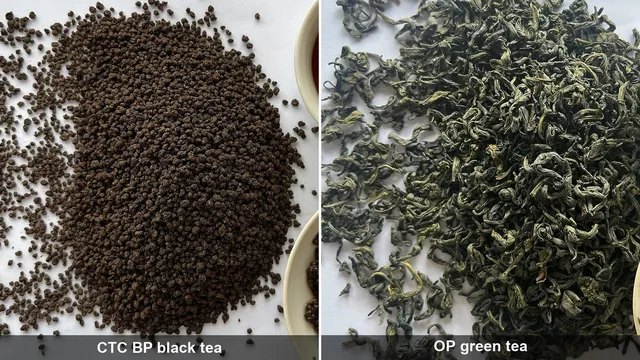
Black tea follows a different path: in 2021 VIOIT described the home market as mostly green and the export market as mostly black. Black tea used to account for 60–70% of the country's tea exports (Công Thương). Green tea has since caught up: in January–May 2025, Vietnam exported 22,800 tons of black tea and 21,600 tons of green (Công Thương).

At home, black tea grows with new drinks. Milk tea, often made with black tea, is big business: Vietnam's bubble tea market reached $362 million in 2021, third in Southeast Asia (VnExpress International). Younger drinkers have also taken to tea bags and instant tea (VIOIT). In bottled tea, Tân Hiệp Phát, URC and Suntory PepsiCo held almost 90% of ready-to-drink sales in 2018, mainly with green tea, oolong and herbal tea (VnExpress International). Our Vietnam tea dust guide covers the black tea grades that milk tea shops use.
How home habits shape what Vietnam exports
These habits split Vietnamese tea into two markets. In 2022 Vietnamese drank about a quarter of the 194,000 tons the country produced, but that quarter was worth more than all the exports:
| 2022 | Drunk in Vietnam | Exported |
|---|---|---|
| Volume (tons) | about 48,000 | about 146,000 |
| Value (US$ million) | about 325 | about 237 |
| Value per kg (US$) | about 6.8 | about 1.6 |
Source: Nguyễn Quốc Mạnh, deputy director of the Department of Crop Production, quoted by VnEconomy, November 2024. Values per kg are our calculation.
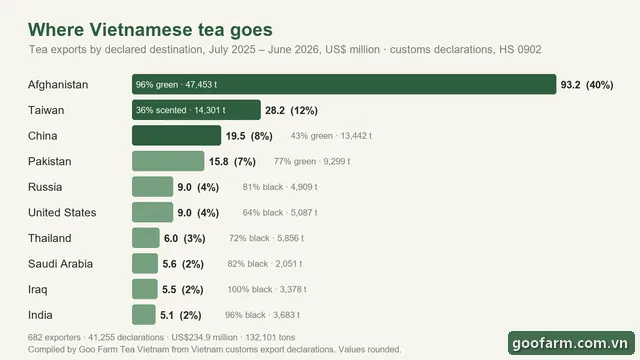
The reason is what each market buys. Home sales are mainly packaged specialty teas, a Vietnam Tea Association report found (VCCI's WTO Center). Exports are mostly bulk tea with little processing (VnExpress), led by buyers in Pakistan, Taiwan and China (Vietnam Customs).
For buyers, that means:
- Bulk grades are Vietnam's strength: black and green tea for blending, tea bags and extraction, below the world average price (VnExpress).
- Famous home teas come in small lots: ask for Tan Cuong green tea, Snow Shan or lotus tea by name, and expect a specialty price.
Frequently asked questions
What tea do Vietnamese people drink every day? Mostly green tea: hot in the north, fresh-leaf tea in central Vietnam and iced tea in the south.
Do Vietnamese people drink black tea? Less than green tea. Most Vietnamese black tea is exported. At home it is drunk mainly as milk tea and in tea bags.
What is trà đá? Iced green tea. It is sold at sidewalk stalls in Hanoi and often served free with meals in the south.
Why is lotus tea so expensive? One kilogram takes 1,000–1,500 fresh lotus flowers and weeks of work, and lotus blooms only in summer.
How much tea does Vietnam drink a year? About 45,000–50,000 tons, a quarter of the country's dry tea output. That is roughly half a kilogram per person (our calculation for 102 million people).
Vietnamese tea from Goo Farm
Goo Farm makes both green and black tea for export. Browse our green tea and orthodox black tea, or read our guide to Vietnamese green tea grades before you ask for samples.