AR
 RU
 ZH
 UZ
 HI
 UR
 FA
 FR
 VI

Tea Import in Pakistan: Where Vietnamese Tea Fits in 2026

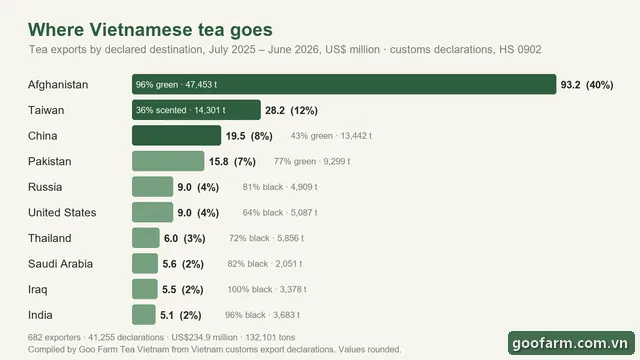
Pakistan is the largest market for Vietnamese tea on paper: 41,337 tons worth US$79.5 million in 2025, a third of Vietnam's tea export value. Pakistan's own figures tell a different story. Tea import in Pakistan is overwhelmingly Kenyan black CTC, and the Vietnamese tea that clears customs in Karachi is mostly green tea, of which Vietnam is by far the largest supplier. This guide starts from those numbers and then covers what a Pakistani importer or packer needs to buy Vietnamese tea: which grades fit, the duties for fiscal year 2026-27, the PS 493 standard, shipping and what the Afghan transit crisis changed.
Figures checked in October 2026 against Pakistan's import data in UN Comtrade, the FBR customs tariff, the Import Policy Order and the Pakistan Tea Association. Rules change with every budget: confirm the current rates with your clearing agent.
What Pakistan imports, in four numbers
- 242,754 tons of bulk black tea in 2025, worth US$614 million. Kenya supplied 217,897 tons, about 90%. Rwanda, Uganda, Tanzania and Malawi followed far behind.
- 8,454 tons of bulk green tea, worth US$16 million. Vietnam supplied 7,341 tons, about 87%, and China most of the rest.
- 1,115 tons of Vietnamese black tea, less than half a percent of Pakistan's black tea imports.
- US$2.46 per kg, the average price of black tea imports in July 2026 according to the Pakistan Tea Association: US$2.51 for Kenyan tea and US$1.08 for Vietnamese.
Why is the Vietnamese export figure so much higher than Pakistan's import figure? In 2023 Vietnam recorded 38,054 tons of green tea shipped to Pakistan, while Pakistan recorded only 5,277 tons of green tea imported from Vietnam. Most of the difference was tea in transit through Karachi to Afghanistan, which Vietnam books as an export to Pakistan. The Vietnam Tea Association says that nearly all Vietnamese green tea exports are drunk in Afghanistan. More on that below.
Where Vietnamese tea fits in a Pakistani range
Pakistanis mostly drink strong black tea boiled with milk, and the market moved to Kenyan CTC decades ago. A Vietnamese supplier does not replace that base. It fills two other roles.
Green tea: the category Vietnam already leads
Vietnamese green tea entered Pakistan at an average of about US$1.89 per kg in 2025 (our calculation from the trade data), which sits in the price band of our OP and Pekoe green grades. For packers of green tea, kahwa blends and green tea bags, the useful grades are:
| Grade | Leaf | Indicative FOB Hai Phong, US$/kg | Tons / 40HC |
|---|---|---|---|
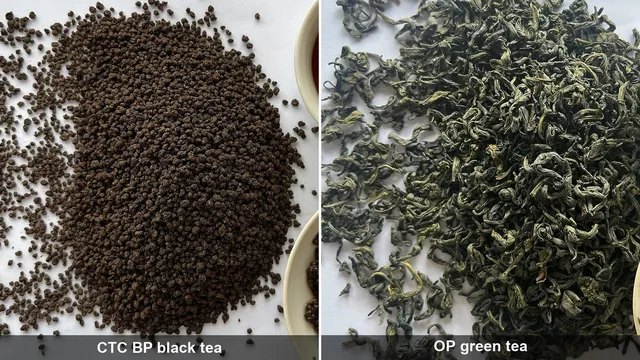
| OP green tea | Big, well-rolled leaf, bright yellow cup | 1.46–2.02 | 17 |
| Pekoe green tea | Bright green, well-rolled leaf | 1.28–2.30 | 18 |
| BOM green tea | Big, open curls, strong cup | 1.00–1.26 | 14 |
| Broken green tea | Small pieces, strong and bright | 0.71–1.10 | 22 |
| BPS green tea | Flat 4–5 mm pieces, for tea bags | 0.61–0.87 | 23 |
Indicative prices in October 2026; the live figures are on our Vietnam tea prices page.
Our guide to Vietnamese green tea grades describes each one in detail.

Black CTC: a price component, not a replacement
Kenyan PF1 and BP1 set the taste most Pakistani drinkers expect. At July 2026 import prices, Vietnamese black tea cost less than half as much per kilogram, which is why some packers test it for part of an economy blend. Our CTC range has four grades:
- PF, the usual tea bag and blending grade, from about US$0.70 per kg FOB, 25 tons per 40HC.
- BP, a big, firm granule for strong tea with milk, from about US$0.71 per kg, 24 tons per 40HC.
- PD and BOP, the finest and the largest granules.
Cup the Vietnamese grade against your Kenyan reference with milk and sugar, the way your customers drink it, before you set a blend ratio.
Duties and taxes on tea, FY2026-27
| Charge | Rate | Status |
|---|---|---|
| Customs duty, all heading 0902 lines | 10% | FBR tariff FY2026-27 (11% in FY2024-25) |
| Additional customs duty | none found for the 10% slab | SRO 1063(I)/2026; ask your clearing agent |
| Regulatory duty | 2% in 2025 | current SRO not checked |
| Sales tax | standard rate, on a minimum value of Rs1,200 per kg set in November 2024 | check whether the minimum value still applies |
| Withholding income tax at import | 5.5% in 2025 | check the current rate |
Pakistan has no free trade agreement with Vietnam, so Vietnamese tea pays the standard rates. The Pakistan Tea Association has argued for years that the total tax burden encourages smuggling and under-invoicing; whatever the outcome of that debate, budget changes arrive every July, so ask for a fresh duty calculation before each contract.
PS 493 and clearing tea in Karachi
Black tea must meet PS 493. Pakistan's Import Policy Order lists black tea, under PCT codes 0902.3000, 0902.4010, 0902.4020 and 0902.4090, among the items that must meet a Pakistan standard at import: PS 493, the Pakistan Standard Specification for Black Tea. Green tea codes are not on that list. Ask your supplier for a laboratory report on water extract, total ash, crude fibre and moisture, the values a black tea standard checks; ISO 3720, which sets the same kind of limits internationally, is a sensible minimum to write into the contract.
Documents to ask for with each shipment:
- Commercial invoice and packing list showing grade, lot and net weight per bag.
- Bill of lading to Karachi or Port Qasim.
- Certificate of origin.
- Phytosanitary certificate issued in Vietnam; your clearing agent will tell you whether your consignment also needs a Department of Plant Protection import permit.
- A laboratory analysis of the lot, and for black tea the data PSQCA will check against PS 493.
Clean tea matters in Pakistan for another reason: provincial food authorities regularly raid units that colour or adulterate tea, and packers who can show the analysis of every lot have an easier time with both regulators and retailers.
The Afghan transit crisis and what it changed
From October 2023 Pakistan removed black tea from the goods allowed in transit to Afghanistan, as a measure against smuggling; green tea stayed on the list. From October 2025 the Pakistan–Afghanistan border closed to trade, and nearly 500 containers of Vietnamese tea, most of them green tea bought by Afghan traders, were stranded in Karachi until Pakistan allowed them to be re-exported on 31 December 2025. Vietnamese exports to Pakistan fell 60% in January–August 2026 as a result.
For a Pakistani importer the lesson is simple: tea bought for consumption in Pakistan clears normally, while tea bought for onward transit depends on a border that can close overnight. Many of the stranded lots had been sold on payment after arrival, which left exporters without payment for months. Terms on which the documents, not the border, release payment, such as a letter of credit or cash against documents, protect both sides.
Shipping and terms
- Ports: Karachi Port and Port Qasim. Routings and transit times from Hai Phong change often, so we confirm the current schedule when you book.
- Incoterms: we quote FOB Hai Phong as standard, and CFR Karachi on request.
- Packing: bulk tea in paper sacks or PP bags in 40HC containers; tons per container differ by grade, as in the tables above. See our packing and loading page.
- Payment: letter of credit at sight, or cash against documents through your bank, agreed in the proforma invoice.

Frequently asked questions
Where does Pakistan import tea from? Mainly from Kenya, which supplied about 90% of Pakistan's bulk black tea in 2025. Rwanda, Uganda, Tanzania and Malawi follow. For green tea the main supplier is Vietnam, with about 87% of the volume in 2025.
How much tea does Pakistan import? About 251,000 tons in calendar year 2025, adding Pakistan's reported imports of bulk black tea (242,754 tons), bulk green tea (8,454 tons) and packed black tea (182 tons). Black tea is about 97% of the total.
What is the customs duty on tea in Pakistan? 10% on all tea lines in the FBR tariff for FY2026-27, plus sales tax, withholding income tax and, in recent years, a regulatory duty. Confirm the full calculation with a clearing agent before you contract.
Is Vietnamese black tea allowed into Pakistan? Yes. Like all imported black tea it must meet the PS 493 standard at the port of entry.
Can Vietnamese tea replace Kenyan tea in a Pakistani blend? Rarely as the base of a strong milk tea blend, because Pakistani drinkers expect the taste of Kenyan CTC. Vietnamese CTC is tested as a lower-cost part of a blend, and Vietnam is already the main origin for green tea.
Does tea for Afghanistan still go through Karachi? Transit trade through Pakistan fell sharply after the border closure of October 2025, and black tea has been barred from Afghan transit since 2023. Check the current status before you buy tea for transit.
Request samples for the Pakistani market
Goo Farm Tea Vietnam makes green tea, orthodox and CTC black tea at factories in Phu Tho and Yen Bai; the Yen Bai factory is ISO 22000:2018 certified. Tell us your current origin and grade, your target price in Karachi and the quantity, and we will send matched samples with an indicative quotation. Contact us.
Sources
- World Bank WITS (UN Comtrade data, as reported by Pakistan), imports of bulk black tea, HS 090240, 2025, bulk green tea, HS 090220, 2025, packed black tea, HS 090230, 2025 and bulk green tea, 2023; Vietnam's green tea exports, 2023, accessed 28 October 2026.
- Pakistan Tea Association, tea import statistics for July 2026, published by the Vietnam Trade Office in Pakistan.
- Federal Board of Revenue, Pakistan Customs Tariff FY2026-27 and S.R.O. 1063(I)/2026, 30 June 2026.
- Ministry of Commerce, Import Policy Order 2022, Appendix N.
- Business Recorder, Tea importers call for reform in taxation regime, 3 May 2025.
- Business Recorder, report on the Afghan transit ban list, 5 October 2023.
- Vietnam News, Pakistan allows re-export of nearly 500 tea containers of Viet Nam stranded at Karachi Port, 31 December 2025.
- Thuong hieu & Cong luan, report on Vietnamese tea containers stranded in Pakistan, 22 December 2025, quoting the Vietnam Tea Association.
- Vietnam Customs, exports by country and main commodity, December 2025.