AR
 RU
 ZH
 UZ
 HI
 UR
 FA
 FR
 VI

Black Tea vs Green Tea: Process, Taste, Caffeine and Uses

Black tea and green tea come from the same plant, Camellia sinensis (NCCIH). The real difference is one step: black tea is rolled and left to oxidize, while green tea is heated at the start so that it cannot oxidize (Tanaka, 2009). This guide compares black tea vs green tea from leaf to cup, as we make them in northern Vietnam, and lists what buyers should check for each.
Two routes from the same leaf
Black tea: wither, roll, oxidize
We wither leaf for black tea on troughs, blowing air through it for several hours until it is soft enough to roll. Orthodox rollers then twist it, or the toothed rollers of a CTC line cut it into granules. Either way, the cells break, so catechins and oxidizing enzymes, kept apart in the living leaf, can mix (Tanaka, 2009). In a cool, humid room the leaf turns copper, then dark brown. Hot air stops the oxidation and dries the tea. Tariffs still call black tea "fermented" (UK Trade Tariff), but the change is oxidation by the leaf's own enzymes.
Green tea: kill-green, roll, dry
In green tea, heat comes first. The fresh leaf is steamed or pan-fired (NCCIH), and the heat inactivates its enzymes. This step is called fixing, or kill-green. The leaf is then rolled and dried. Shapes range from large, open leaves to the tight, gunpowder-like rolls of our Madina green tea. Because the enzymes stop early, green tea keeps a polyphenol makeup close to that of the fresh leaf (Tanaka, 2009).
Black tea vs green tea at a glance
| Feature | Black tea | Green tea |
|---|---|---|
| Oxidation | Full | None; heat stops the enzymes |
| Main polyphenols | Theaflavins, thearubigins | Catechins, mainly EGCG |
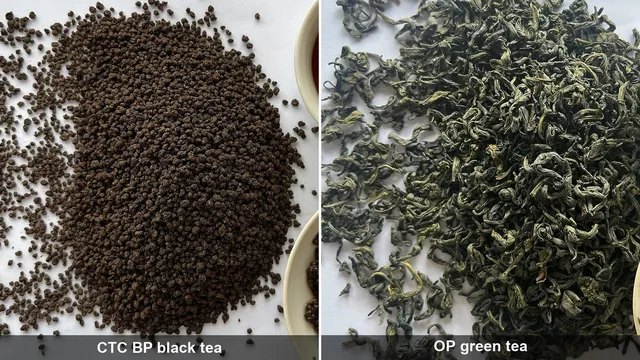
| Dry leaf | Black to dark brown | Yellow-green to dark green |
| Liquor | Golden red to ruby red | Yellow to green |
| Taste | Malty, brisk; takes milk well | Fresh, vegetal, some bitterness |
| Caffeine, typical 12 fl oz (355 ml) | About 71 mg | About 37 mg |
| Main uses | Tea bags, milk tea, chai, blends | Loose leaf, jasmine tea, tea bags, extract |
| Tons per 40HC | 13–28, by grade | 14–28, by grade |
| HS code | 0902.30, 0902.40 | 0902.10, 0902.20 |
Sources: FDA (caffeine), Harvard and Tanaka, 2009 (polyphenols), UK Trade Tariff (HS codes). Container loads are our own figures.
Leaf grades: same names, different leaf
Sieves sort both teas into grades by leaf size and shape; a grade is not a quality score. OP, OPA, Pekoe, PS, BPS, fannings, dust and stalk exist in both our orthodox black tea and green tea ranges. FBOP, BOP and the CTC grades are black only; Madina, BOM and Snow Shan are green only.
The same name can mean a different leaf. Black Pekoe is well curled, black and heavy, with an orange-red liquor; green Pekoe is well rolled and bright green, with a green liquor.
Leaf size and shape, not tea type, decide how much fits in a container. With standard packing, a 40-foot high cube holds about 17 tons of OP, 26 tons of fannings and 28 tons of dust in either tea. PS differs most, at about 18 tons in black and 22 in green. See packing and loading.
In the cup: liquor, aroma and flavor
Theaflavins are orange-red pigments, and thearubigins give black tea much of its color (Leung, 2001; Tanaka, 2009). Our orthodox grades brew golden red with an orange tint. They have a lively, floral aroma and a malty, brisk taste with citrus notes. CTC grades brew faster, darker and ruby red, strong enough for milk and sugar.
Green tea keeps much of the fresh leaf's green color. Our grades brew from bright yellow (OP, OPA) to bright green (Pekoe, BOM). OP is strong and vegetal, with clear bitterness and light astringency. Snow Shan, from wild trees above 1,000 meters in the mountains of northern Vietnam, is softer, floral and slightly nutty.
Caffeine and antioxidants: what the research says
Typical values put black tea higher: the US FDA lists about 71 mg of caffeine in 12 fl oz (355 ml) of black tea and 37 mg in green tea. A study of 20 commercial teas found 14–61 mg per 6–8 oz serving, with no clear trend by tea type; steeping time mattered (Chin, 2008). Grade (particle size), tea bags, the amount of tea and brewing time also change what reaches the cup (Astill, 2001).
Both teas contain polyphenols, but different ones. Green tea keeps its catechins, mainly EGCG (Harvard). In black tea, oxidation turns catechins into theaflavins and thearubigins (Tanaka, 2009). In a laboratory test, black tea theaflavins were at least as strong antioxidants as green tea catechins (Leung, 2001). That does not prove a benefit in people. NCCIH, part of the US National Institutes of Health, reports inconsistent or small effects in studies of green tea and health. We make no health claims for our teas.
How each tea is used
- Black tea: CTC PF and PD or orthodox BPS, PS and F1 for tea bags; PD, F1 and tea dust for milk tea, bubble tea and chai; PF as a breakfast base; OPA, PS, TH and stalk in our Earl Grey; OPA, OP and Pekoe as loose leaf.
- Green tea: OP, OPA, Pekoe and Madina as loose leaf; OP for scented tea such as our Jasmine OP Green Tea; BPS, PS, fannings and dust for tea bags and extract.
What to check when buying from Vietnam
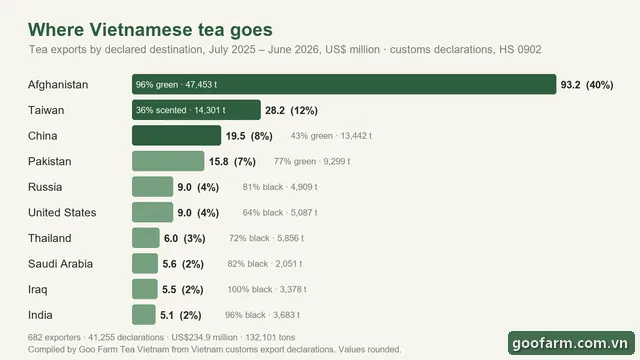
Vietnam ships both teas in similar volumes: about 51,100 tons of bulk black tea and 53,900 tons of bulk green tea in 2023, with Pakistan taking about 71% of the green (WITS black; WITS green). FAO data put Vietnam second only to China among green tea exporters (FAO).
For either tea, brew samples of two neighboring grades side by side, the way your customers drink tea. The approved sample becomes the standard for the order. Then check:
- Black tea: orthodox or CTC; liquor color and brightness; strength with milk, if your market adds it; an even leaf or granule with little fiber. For tea bags, agree on particle size and moisture.
- Green tea: dry leaf and liquor color against the sample, and a level of bitterness your market accepts. Ask for the production date and airtight packing, such as vacuum aluminum bags. In a USDA study, catechins in green tea bags fell steadily over six months at 20 °C (Friedman, 2009).
- Documents: black and partly fermented tea such as oolong is HS 0902.30 (packs up to 3 kg) or 0902.40; green tea is 0902.10 or 0902.20. Agree on the certificate of origin, phytosanitary certificate, certificate of analysis and any SGS or Dai Viet Control inspection or Eurofins lab testing. Residue limits (MRLs) still differ by market (FAO). Our Yen Bai factory is ISO 22000:2018 certified by Vinacontrol (certificate No. 31905-FSV).
- Freight: 13–28 tons per 40HC by grade. Black and green grades can share a mixed container.
Frequently asked questions
Are black tea and green tea made from the same plant? Yes, both come from Camellia sinensis. Our black and green teas use leaf from the same provinces of northern Vietnam; only the processing differs.
Does black tea have more caffeine than green tea? Usually: about 71 mg against 37 mg per 12 fl oz (FDA). Real cups overlap, because grade, amount and steeping time matter.
Is green tea healthier than black tea? There is no clear answer. Their polyphenols differ but showed similar antioxidant strength in a laboratory test, and studies in people show inconsistent or small effects.
Which is better for milk tea? Black tea. CTC PD and PF, F1 and dust grades brew fast and dark and stay strong under milk and sugar.
Can I order black and green tea in one container? Yes, black and green grades can share a mixed container. Many buyers start with a trial order of one grade, then move to a mixed container.
Samples of black and green tea
The best way to compare black tea vs green tea is in your own cup. Choose from our orthodox black tea and green tea grades, then contact us with the grades, quantity and destination port. We will send samples with a specification sheet.