AR
 RU
 ZH
 UZ
 HI
 UR
 FA
 FR
 VI

CTC Tea Grades: Kenya, India, Sri Lanka and Vietnam Compared

In short: No official table equates CTC grades across Kenya, India, Sri Lanka and Vietnam, so match by sample. Goo Farm's nearest matches: CTC PF for Kenyan PF1, BP for Kenyan BP1, PD for PD; our four CTC grades load 23–26 tons per 40HC.
A buyer writes: "We pack Kenyan PF1. What is your equivalent?" Another sends a Ceylon BOPF specification, a third an Assam BOPSM. Each of them uses the CTC tea grades of the country they know, and none of those names maps one to one onto another country's list. There is no official cross-country equivalence table: Kenya, India and Sri Lanka each grade with their own sieves and auction rules, and the same letters can describe different teas. This page sets the four systems side by side, Kenya, India, Sri Lanka and Vietnam, explains where the names agree and where they mislead, and shows how we match a foreign grade to one of our own samples.
Grade lists checked against the Tea Board of India auction rules, KTDA factory pages, the Tea Exporters Association Sri Lanka and broker reports, October 2026. Sources are listed at the end.
Why the same letters do not mean the same tea
Three things get in the way of a simple translation:
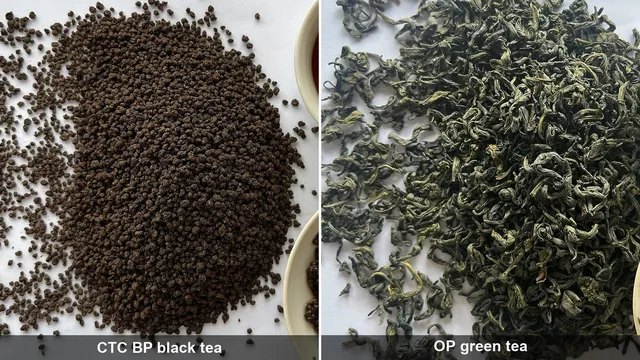
- Two processes, one alphabet. CTC (crush, tear, curl) cuts the leaf into round granules; orthodox rolling twists and breaks it. Both use BOP, BP, PF and D, but a CTC BOP is a granule and an orthodox BOP is a piece of broken leaf. Our guide to FBOP and BOP shows the two side by side.
- Each country sieves its own way. We found no published sieve table that Kenya, India and Sri Lanka share. A Kenyan PF1 and an Indian PF1 carry the same code, but nobody guarantees the same particle size.
- Numbers mean different things. In Kenya the "1" marks a primary grade, in Sri Lanka OP1 is a wirier leaf than OP, and in Vietnam F1, F2 and F3 are quality levels of one size. The section on numbers below sets them out.
So treat any equivalence, including ours, as a starting point. The sample, not the name, closes the deal.
CTC tea grades by country: the comparison chart
The chart groups each country's CTC grades by size, from the largest granules to the finest dust. Kenya and Sri Lanka use only a handful of CTC names; India's Tea Board lists many more, because Indian auctions split brokens and dusts finely.
| Size group | Kenya | India | Sri Lanka | Vietnam (Goo Farm) |
|---|---|---|---|---|
| Large brokens | BP1; BP | BOPL, BOP, BOPSM, BP, BP1, BPSM | BPS, BP1, BPL | BOP, BP |
| Fannings | PF1; PF, F1, FNGS, BMF | OF, OF1, PF, PF1, BOPF | PF1 | PF |
| Dust | PD, D1; Dust | PD, PD1, D, D1, CD, RD, RD1, SRD, FD, GD | PD | PD |
Kenya: primary grades first, secondary grades after the semicolon, as listed on KTDA factory pages. India: CTC grades in the Tea Board's official list. Sri Lanka: CTC grades in the Tea Exporters Association list. Vietnam: our CTC range.
Two names cross every border: PF1 and PD appear in all three producing countries, and BP1 in Kenya, India and Sri Lanka. Those shared codes are the safest place to start a match, though not a guarantee of identical size.
How our CTC range lines up
| Goo Farm CTC grade | Granule | Nearest foreign grades to sample against | Tons / 40HC |
|---|---|---|---|
| BOP | Largest, firm, black to dark brown | India BOP, BOPL | 23 |
| BP | Big and firm | Kenya BP1, India BP, Sri Lanka BP1 | 24 |
| PF | Small, even | Kenya PF1, India PF, Sri Lanka PF1 | 25 |
| PD | Finest granule | Kenya PD, India PD, Sri Lanka PD | 26 |

Inside each grade we keep several standards. PF, for example, runs from PF through PF1 to PF2 and PF3 in our sample catalogue, and BP from small BP to BP1 and BP2. When a buyer names a Kenyan grade, we usually send two or three of these standards so the buyer can pick the closest cup.
Orthodox grades: Sri Lanka, India and Vietnam
Orthodox tea is where Sri Lanka and Vietnam meet most often, because both sell rolled leaf to the same markets in the Middle East and the CIS. Kenya sells mainly CTC: the Mombasa main-grade quotations cover only BP1, PF1, PD and D1, so Kenya drops out of this chart.
| Size group | Sri Lanka | India | Vietnam (Goo Farm) |
|---|---|---|---|
| Whole leaf | OPA, OP, OP1, Pekoe, Pekoe1 | OP, OP-A, FOP, GFOP, TGFOP and longer tippy grades | OPA, OP, Pekoe, TH |
| Broken | BOP, BOP1, FBOP, FBOP1 | BOP, BOP1, FBOP, GBOP, GFBOP, TGBOP | FBOP, BOP, PS, BPS |
| Fannings | BOPF, FBOPF, FBOPF1, FBOPFSp, FBOPFExSp | BOPF, OF, FOF, GOF | F1, F2, F3 |
| Dust | Dust, Dust1 | BOPD, SD | Dust 1, Dust 2, Dust 3 |
India's long tippy names, such as TGFOP or GFBOP, describe golden tips that are rare in Vietnamese export tea; apart from FBOP, which carries a few silver tips, our orthodox grades are described by leaf size, liquor and taste. Two of our grades have no foreign twin at all: TH, a short wiry leaf used under Earl Grey, and PS, a flaky Pekoe Souchong that sits between broken leaf and fannings.

What the numbers after a grade mean
| Example | Country | What the number tells you |
|---|---|---|
| BP1, PF1, D1 | Kenya | A primary grade; BP, PF and Dust without the 1 are secondary grades sold in separate catalogues |
| OP1, Pekoe1, BOP1 | Sri Lanka | A different leaf style: OP1 is wirier than OP, Pekoe1 smaller than Pekoe |
| FTGFOP1, BOP1 | India | The top lot of that style; in CTC, BP1 and PF1 sit beside BP and PF on the official list |
| F1, F2, F3; Dust 1, 2, 3 | Vietnam | Quality levels of one size: 1 is the best, 3 the plainest |
The practical rule: never compare a "1" across borders. A Kenyan PF1 is a primary CTC grade made in large volume; a Vietnamese F1 is the top level of our orthodox fannings. Compare the cup instead.
Prices: where each origin sits
Auction prices and FOB prices are not the same thing: auction prices are paid for tea in the producing country before export costs, and they move every week. With that caution, the 2025–2026 figures show the gap between origins:
- Kenya, Mombasa: an average of about US$2.28 per kg over the first 24 sales of 2026. At Sale 33 in August 2026, medium KTDA PF1 sold at about US$2.32–2.80 per kg and plainer PF1 at US$1.12–1.57.
- Sri Lanka, Colombo: a 2025 national average of Rs 1,167.72 per kg, about US$3.88, mostly orthodox tea.
- India: an all-India auction average of Rs 186.92 per kg in 2025, roughly US$2.1–2.2 at that year's exchange rates, with North India well above South India.
- Vietnam: an average export price of US$1,737 per ton in 2025, according to Vietnam Customs, or about US$1.74 per kg (Vietnam tea exports).
Our own indicative FOB Hai Phong prices sit inside the Vietnamese range: in October 2026, PF from about US$0.70 and PD from about US$0.53 per kg, with the higher standards of each grade priced well above that. The live figures are on our Vietnam tea prices page. Price is the main reason buyers of Kenyan or Indian CTC sample Vietnamese grades for part of a blend.
The one standard every origin shares
While grade names differ, the chemistry of black tea is defined once, in ISO 3720:2011. Vietnam adopted it word for word as TCVN 1454:2013. It applies whatever the grade or the country:
| Requirement, dry basis | Limit |
|---|---|
| Water extract | 32% minimum |
| Total ash | 4% to 8% |
| Water-soluble ash | at least 45% of total ash |
| Alkalinity of water-soluble ash (as KOH) | 1.0% to 3.0% |
| Acid-insoluble ash | 1.0% maximum |
| Crude fibre | 16.5% maximum |
| Total polyphenols | 9% minimum |
If your contract names a grade from another country, add ISO 3720 as the quality floor. It turns "equivalent to Kenyan PF1" from an opinion into something a laboratory can check.
How to ask us for an equivalent
- Name the origin and the grade exactly, for example "Kenya PF1, medium KTDA" or "Ceylon low grown BOPF". The origin matters as much as the letters.
- Say what the tea is for: tea bags, milk tea, loose packs or a blend, and whether it is drunk with milk.
- Send a reference sample if you can, or a photo next to a ruler. We match it to the closest of the STD sample codes in our catalogue, each with a photo of the actual dry leaf.
- Taste two or three standards side by side. We send the nearest standards of one grade so you choose by the cup, not by the name.
- Write the approved STD code into the contract, together with packing and tons per container. See bulk tea from Vietnam for the steps from sample to loading.
Frequently asked questions
Is Kenyan PF1 the same as Indian PF1? Not necessarily. Both countries use the code for a CTC pekoe fannings grade, but each grades with its own sieves, and no shared standard fixes the size. Taste and compare samples before you switch origins.
What is the Vietnamese equivalent of Kenyan BP1? Our nearest grade is CTC BP, a big, firm granule; CTC BOP is slightly larger. We send both when a buyer quotes BP1.
Which CTC grade is best for tea bags? PF is the usual tea bag grade in every origin, with PD or dust for very fast, dark brews. Larger brokens such as BP and BOP suit loose tea and strong tea with milk.
What does BMF mean in Kenyan tea? Broken Mixed Fannings, a secondary grade sold in the Mombasa secondary catalogues and used in economical blends.
Does Vietnam make CTC tea? Yes. Vietnam makes both orthodox and CTC black tea. Our CTC range has four grades, BOP, BP, PF and PD, described in our guide to Vietnam CTC black tea.
Where can I see all tea grade names explained? Our guide to tea leaf grades explains every letter from OP to dust; this page only compares countries.
Send us your grade, get a matched sample
Goo Farm Tea Vietnam makes CTC and orthodox black tea, green tea and tea dust at factories in Phu Tho and Yen Bai; the Yen Bai factory is ISO 22000:2018 certified. Tell us the foreign grade you buy today, the quantity and the destination port, and we will send the closest standards with an indicative FOB price. Contact us.
Sources
- Tea Board of India, Jorhat Auction Rules, Annexure D: Grades of Tea (CTC, Orthodox), February 2020.
- Tea Board of India, Month-wise prices of all tea at Indian auctions, 2025 and 2025-26.
- Kenya Tea Development Agency, factory pages listing primary and secondary grades, for example Toror Tea Factory, accessed October 2026.
- National Brokers Ltd, weekly market report covering Mombasa Sale 33, 17–18 August 2026.
- Food Business MEA, report on Kenyan auction averages to June 2026, 25 June 2026.
- Tea Exporters Association Sri Lanka, Tea grades, accessed October 2026.
- Forbes & Walker Tea Brokers, National tea sale averages, December 2025, and weekly report, Sale 34, September 2025.
- ISO, ISO 3720:2011 Black tea: Definition and basic requirements, confirmed 2021.