AR
AR RU
RU ZH
ZH UZ
UZ HI
HI UR
UR FA
FA FR
FR VI
VI
Tea Leaf Grades Explained: OP, FOP, BOP, Fannings and Dust

Tea leaf grades describe the size and form of the dried leaf, not how good the tea is. Orange Pekoe (OP) and its longer relatives such as FOP and TGFOP are whole-leaf grades, BOP and BPS are broken-leaf grades, and fannings and dust are the smallest particles, sorted out on fine sieves for tea bags and milk tea. This guide explains what each grade name means, where the letters come from, how CTC and green tea are graded, and how the grades we produce in Vietnam line up with the international system — with the container load and the usual use of each grade, so you can choose the right one for your product.
What tea leaf grades measure — and what they do not
After black tea is dried, it is passed over a stack of sieves with smaller and smaller mesh. Each fraction that stays on a sieve becomes a grade. A grade name therefore tells a buyer three things:
- Leaf size and form: whole leaf, broken leaf, fannings or dust.
- How the tea brews: the smaller the particle, the faster and darker the infusion, because more leaf surface meets the water.
- Bud content, in the longer names: words such as flowery, golden and tippy promise a share of buds, or tips, in the leaf.
A grade does not tell you the type of tea, the garden, the season or the quality of the cup. Black, green, oolong and white are tea types, made by different processing; OP, BOP or PF are grades within a type. Two lots of the same grade can taste very different, and the fannings of a fine garden can cost more than the whole leaf of an ordinary one.
Standards work the same way. The international standard for black tea, ISO 3720:2011, which Vietnam adopted as TCVN 1454:2013, defines black tea by its plant source and chemical requirements, not by leaf size. The leaf grade is a trade description that buyer and seller agree on, with an approved sample as the reference.
Where the names come from: pekoe, orange, flowery and souchong
The vocabulary of tea grading was built by European merchants buying Chinese tea, and later standardised by the tea plantations of India and Ceylon.
- Pekoe most likely comes from the Amoy Chinese pek-ho (白毫), "white down": the fine silvery hairs on an unopened tea bud.
- Orange has no Chinese origin. One explanation links it to the Dutch House of Orange-Nassau, whose East India Company traded tea; another to the coppery-orange colour of well-oxidised leaf. Either way, it has nothing to do with orange flavour.
- Flowery means more buds and tips, golden means tips that turned golden during oxidation, and tippy means a high proportion of them.
- Souchong names the larger, coarser leaves further down the shoot.
Behind these names is the tea shoot itself: the bud at the tip, then the first leaf, the second leaf and the larger leaves below. Fine plucking, "two leaves and a bud", takes only the top of the shoot. Older tea books map the grade names onto the shoot — the bud as flowery orange pekoe, the first leaf as orange pekoe, the second as pekoe and the lower leaves as souchong. Today the names describe the size of the finished leaf after sieving, not which leaf on the shoot it came from.

Tea leaf grades at a glance: the four size groups

Every grade belongs to one of four groups. The last column is how many tons fit in a 40-foot high cube (40HC) container with our standard packing, which shows how leaf size turns into freight cost.
| Group | Example grades | Dry leaf | In the cup | Typical use | Tons / 40HC |
|---|---|---|---|---|---|
| Whole leaf | OP, OPA, Pekoe, FOP | Long, twisted or curled leaves | Slower infusion, more aroma, lighter body | Loose-leaf packs, pyramid bags, scented blends | 13–17 |
| Broken leaf | BOP, FBOP, PS, BPS | Pieces of leaf | Faster and stronger, leaf still visible | Loose tea, premium tea bags, breakfast blends | 18–22 |
| Fannings | F, PF, BOPF, OF | Small particles | Very fast, strong and dark | Standard tea bags, tea extract | 26 |
| Dust | D, D1, PD | Fine powder | Fastest and darkest | Tea bags, milk tea, bubble tea | 28 |
Whole-leaf grades: from OP to SFTGFOP
Whole-leaf grade names are built by adding letters in front of OP. Each added letter claims more buds or a finer selection, and a "1" at the end marks the best lots within that grade.
| Grade | Stands for | What it means |
|---|---|---|
| OP | Orange Pekoe | The basic whole-leaf grade: long, wiry or twisted leaf without tips |
| OP1 | Orange Pekoe 1 | A finer, more delicate OP with a lighter liquor |
| OPA | Orange Pekoe A | Bolder and larger leaf than OP |
| P | Pekoe | Shorter, more curled leaf than OP |
| FOP | Flowery Orange Pekoe | Whole leaf with some tips |
| GFOP | Golden Flowery Orange Pekoe | FOP with golden tips |
| TGFOP | Tippy Golden Flowery Orange Pekoe | A high proportion of golden tips |
| FTGFOP | Finest Tippy Golden Flowery Orange Pekoe | The top quality of TGFOP |
| SFTGFOP | Special Finest Tippy Golden Flowery Orange Pekoe | The finest lots of FTGFOP |
The long, tippy names belong mainly to Darjeeling, Assam and Nepal, where they are printed on single-estate teas. Vietnamese orthodox black tea for bulk export uses the shorter scale: our whole-leaf grades are OPA, OP, Pekoe and TH, described in detail in our guide to Vietnam orthodox black tea.

Broken-leaf grades: BOP, FBOP, BP, PS and BPS
Broken grades are pieces of leaf that passed through the coarser sieves. They brew faster and stronger than whole leaf while still showing leaf, which makes them the workhorse grades for tea bags and strong loose tea.
| Grade | Stands for | What it means |
|---|---|---|
| BOP | Broken Orange Pekoe | The main broken grade in most producing countries |
| FBOP | Flowery Broken Orange Pekoe | Broken leaf with some tips, a little coarser than BOP |
| FBOPF | Finest Broken Orange Pekoe Flowery | A Sri Lankan grade rich in tips; the last F means flowery, not fannings |
| GFBOP1 | Golden Flowery Broken Orange Pekoe 1 | The best lots of broken leaf with golden tips |
| TGFBOP1 | Tippy Golden Flowery Broken Orange Pekoe 1 | Broken leaf with a high share of tips, typical of Darjeeling |
| BP | Broken Pekoe | A common broken grade in Indonesia, Sri Lanka and India |
| PS | Pekoe Souchong | Flaky pieces from the larger leaves |
| BPS | Broken Pekoe Souchong | Smaller pieces than PS, with a stronger cup |
Because of its tips, FBOP is normally the higher grade of the two. In Vietnam, FBOP and BOP, PS and BPS are the broken orthodox grades buyers ask for most; BPS is the usual choice for tea bags and tea extract.
Fannings and dust grades
Fannings and dust are the finest fractions of the sieve. They are not sweepings: they are cleaned, sorted and graded like any other tea, and they fill most of the world's tea bags, because small particles infuse within a minute or two and fill a bag evenly.
| Grade | Stands for | What it means |
|---|---|---|
| PF | Pekoe Fannings | Small, even particles; a main tea bag grade, especially in CTC |
| BOPF | Broken Orange Pekoe Fannings | The main fannings grade in Sri Lanka, Indonesia, Kenya and southern India |
| OF | Orange Fannings | Fannings from northern India, Nepal and parts of Africa |
| FOF | Flowery Orange Fannings | Fannings with some tips, close in size to the small broken grades |
| GFOF | Golden Flowery Orange Fannings | Fine Darjeeling fannings for tea bags |
| BMF | Broken Mixed Fannings | Mixed fannings, an economical blending grade |
| PD | Pekoe Dust | The coarsest dust grade |
| D1 | Dust 1 | The first dust grade: fine, dense and dark |
Fannings of an expensive tea can still taste better than the whole leaf of a cheap one. Our tea dust range covers orthodox fannings, dust and the CTC grades PF and PD — see our guide to Vietnam tea dust.

CTC tea grades
CTC (crush, tear, curl) cuts the withered leaf into small, hard granules instead of rolling it. The tea brews fast, strong and red, which is why CTC fills most tea bags and most milk tea. Because every particle is a granule, CTC has its own, shorter grading scale based on granule size alone — from the largest to the smallest: BOP, BP, PF, PD and D.
In Kenya, the world's largest exporter of black tea, the main CTC grades sold at the Mombasa auction are BP1, PF1, PD and D1, with PF, dust, fannings and BMF as secondary grades. Our CTC range follows the same scale:
| Goo Farm CTC grade | Granule | Typical use | Tons / 40HC |
|---|---|---|---|
| BOP | The largest; firm, black to dark brown | Loose CTC tea, premium tea bags | 23 |
| BP | Big and firm | Tea bags, chai, strong tea with milk | 24 |
| PF | Small (Pekoe Fannings) | English Breakfast, masala chai, standard tea bags | 25 |
| PD | The finest (Pekoe Dust) | Tea bags, milk tea, instant tea | 26 |
Note that a CTC BOP is a granule size and looks nothing like an orthodox BOP leaf, so always say which process you mean. More in our guide to Vietnam CTC black tea.
How Vietnamese export grades match the international system
Vietnam's former national standard for loose black tea, TCVN 1454:1993, listed seven orthodox grades: OP, FBOP, P, PS, BPS, F and D. Those seven names are still the backbone of Vietnamese export grading. Factories add a few trade grades on top — OPA for extra-large leaf, TH for short, wiry leaf, and stalk — and use numbers to split one size into quality levels: F1 is the first fannings grade and F2 and F3 are lower grades of the same size; Dust 1 is the first dust, Dust 2 and Dust 3 the lower ones. As in India and Sri Lanka, "1" marks the best.
| Vietnamese grade | International equivalent | At Goo Farm | Tons / 40HC |
|---|---|---|---|
| OPA | OPA (bold OP) | Long, slightly twisted leaf, our largest | 13 |
| OP | OP | Slightly curled leaf of regular size | 17 |
| Pekoe | Pekoe (P) | Heavy, well-curled leaf, shorter than OP | 16 |
| TH | No direct equivalent | Short, wiry leaf; a base for Earl Grey | 13 |
| FBOP and BOP | FBOP, BOP | Short broken leaf; FBOP has silvery tips | 22 and 20 |
| PS | Pekoe Souchong | Neat, flaky leaf; smooth and malty | 18 |
| BPS | Broken Pekoe Souchong | Small, flaky leaf with a strong cup | 22 |
| F1, F2 and F3 | Fannings (BOPF, OF) | Small particles, quick and strong | 26 |
| Dust 1, Dust 2 and 3 | D1, dust | Fine powder | 28 |
| Stalk | No direct equivalent | Stalks of 0.5–1 cm | 16 |
A grade still covers a range of lots. On our tea specifications page every sample carries an STD code and a photo of the actual dry leaf: the grade names the size group, the STD code names one exact standard within it.
Green tea and oolong: the same letters, a different system
The OP system was written for black tea and is little used in China, where green and oolong teas are named by style, region and season instead. Vietnamese green tea, made largely for export, borrows the black tea letters to describe leaf size — OP, OPA, Pekoe, PS, BPS, fannings and dust — and adds style names such as BOM, a big, well-rolled leaf from young shoots, and Madina, rolled tightly like gunpowder tea. Liquor colour rather than tips separates many of them: OP and OPA brew bright yellow, Pekoe and BOM bright green. See our guides to Vietnamese green tea grades and BOM green tea.
Oolong is graded by cultivar, rolling and season rather than by letters; our Jin Xuan oolong is described in Vietnam oolong tea.
Does a higher tea leaf grade mean better tea?
Not necessarily. A grade is the right size for a job, and the best grade is the one that suits your product:
| You make | Grades to sample |
|---|---|
| Loose-leaf retail packs | OPA, OP, Pekoe; FBOP for visible tips |
| Premium pyramid tea bags | OP, FBOP, BOP |
| Standard tea bags | BPS, PS, F1, CTC PF |
| Milk tea, bubble tea, teh tarik | Dust 1, CTC PD, BPS |
| Tea extract and instant tea | BPS, fannings, dust |
| Earl Grey and flavoured blends | OPA, PS, TH, stalk |
Price follows size and selection: larger leaf and more tips cost more per kilogram. Large leaf also costs more to ship. A 40HC holds about 13 tons of OPA but 28 tons of dust, so the freight per kilogram of OPA is more than double that of dust. For indicative prices grade by grade, see Vietnam tea prices.
How to specify a tea grade when you buy in bulk
- Name the type and the process: orthodox black, CTC black or green tea. "BOP" means different things in orthodox and in CTC.
- Name the grade and the supplier's code. Our STD codes on the tea specifications page pin down one standard within a grade.
- Agree on the four description lines: liquor, appearance, aroma and flavour.
- For tea bag and extract lines, add particle size and moisture. Particle size decides how the tea runs through your packing machine and whether it sifts through the bag paper; moisture decides shelf life.
- Approve a sample. Brew it the way your customers drink it and compare it with your current supply. The approved sample becomes the standard for the order, and every order we ship is the same as or better than that sample.
- Fix the packing and the quantity: PP/PE bags, kraft paper sacks or export cartons, and how many tons of your grade fit in a container — see packing and loading.
Frequently asked questions
What are the main tea leaf grades? There are four groups: whole leaf (OP, Pekoe, FOP and the longer names), broken leaf (BOP, FBOP, PS, BPS), fannings (PF, BOPF, F) and dust (PD, D1). They are separated by sieve size after the tea is dried.
What does orange pekoe mean? Orange Pekoe (OP) is the basic whole-leaf grade of black tea: long leaves without tips. "Pekoe" probably comes from a Chinese word for the white down on tea buds, and "orange" is an old trade term, possibly after the Dutch House of Orange-Nassau. It is not an orange-flavoured tea.
What does FTGFOP mean? Finest Tippy Golden Flowery Orange Pekoe: whole leaf with a high share of golden tips, from the best lots. It is used mostly for Darjeeling and Assam estate teas.
What is the difference between OP and BOP? OP is whole leaf; BOP is broken leaf. BOP brews faster and stronger, while OP gives more aroma and a lighter body. A 40HC container holds about 17 tons of our OP and 20 tons of our BOP.
Are fannings and dust low-quality tea? No. They are the smallest sizes, not rejects. They brew the fastest and darkest, fill most of the tea bags sold worldwide, and fannings from a good garden can be better than whole leaf from a poor one.
What does the number after a grade mean, as in F1 or Dust 2? It splits one size into quality levels, and "1" is the best. F1 is the first fannings grade; F2 and F3 are lower grades of the same size.
Which tea grade is best for tea bags? BPS, PS and fannings such as F1 for orthodox tea bags, CTC PF for strong breakfast-style bags, and dust for the strongest, darkest cup. Premium pyramid bags use OP, FBOP or BOP, where the leaf is visible.
Request samples of Vietnamese tea grades
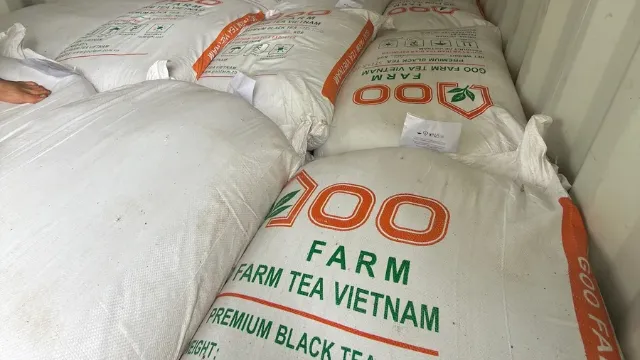
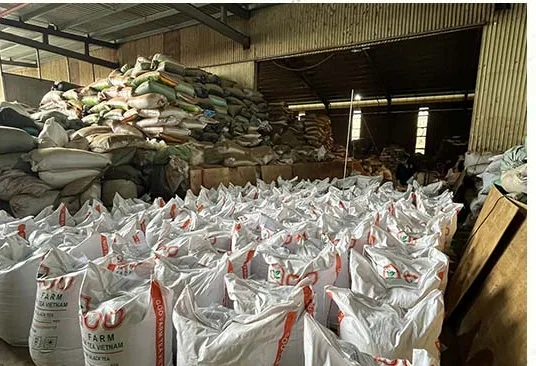
Goo Farm Tea Vietnam produces black, green, CTC and oolong tea in 47 grades at our own factories in Phu Tho and Yen Bai — the Yen Bai factory is certified to ISO 22000:2018 — and exports to more than 30 countries. Tell us what you make, the tea leaf grades you are considering, the quantity and your destination, and we will send samples with a specification sheet for each. Contact us, or browse all our Vietnamese tea grades.
Sources: Wikipedia, Tea leaf grading; ISO, ISO 3720:2011 Black tea — Definition and basic requirements; Vietnam national standards TCVN 1454:1993 (loose black tea) and TCVN 1454:2013; container loads from our packing and loading table.